


Expansive Translation: Becoming a Translation Experimenter
When we translate, what do we mean by fidelity? What do we preserve, destroy, or add when carrying text across languages—and why?
Translation theory, the branch of literary theory invested in translation, has spent years debating questions of faithfulness, form, meaning, and transformation. Walter Benjamin’s The Task of the Translator tells us that translation itself is not merely a transmutation of some other text—it is a literary form unto itself, with its own laws and conventions, including what to bring along and leave behind. We tend to think that a “faithful” translation involves prioritizing semantic meaning over other attributes—but Benjamin reminds us that a poem’s meaning is equally tied up with aspects like sound, meter, or visual form that may be important in themselves. How might we use these aspects to our advantage, and view this recreation as a process of both loss and gain?
My BLUE project aims to create new methods of experimental translation to help us move through text in new ways. Challenging the myth of the translator’s invisibility, I hope to change translation from its misconception as a rote, passive act into a space of exploration, experimentation, and play.
Translation as Form, Language as Material
Translation theory, the branch of literary theory invested in translation, has spent years debating questions of faithfulness, form, meaning, and transformation. Walter Benjamin’s The Task of the Translator tells us that translation itself is not merely a transmutation of some other text—it is a literary form unto itself, with its own laws and conventions, including what to bring along and leave behind. We tend to think that a “faithful” translation involves prioritizing semantic meaning over other attributes—but Benjamin reminds us that a poem’s meaning is equally tied up with aspects like sound, meter, or visual form that may be important in themselves.
My BLUE project explored translation with a focus on sound and form, rather than semantic meaning, and emphasized the active role that a translator plays in navigating linguistic space. Challenging the myth of the translator’s invisibility, I hope to change translation from its misconception as a rote, passive act into a space of exploration, experimentation, and play.
During my project, I first experimented with different metaphors for translation, which I drew from translation theory and my own explorations. I also considered the ways in which translating machines have flattened language into semantic meaning and standardized, anodyne linguistic registers, and worked through sound.
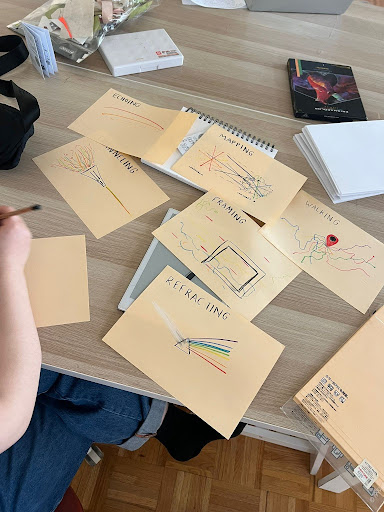
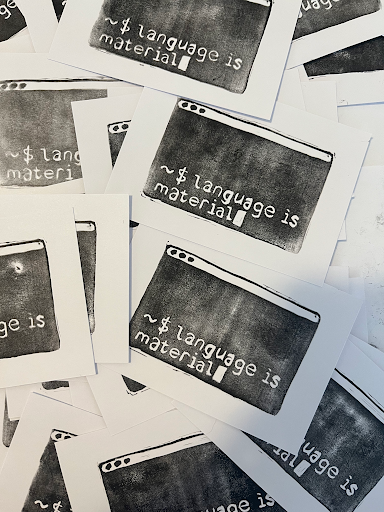
My final showcase incorporated illustrations of the ideas I explored alongside an installation called LANGUAGE IS MATERIAL. The installation consists of a set of 65 small prints produced through a Reduction Printing process that mimics typing in a computer terminal. In Reduction Printing, the printmaker produces a series of prints while slowly cutting down the original block, so that these prints are no longer directly reproducible at the end of the process. Challenging the digitally-mediated, frictionless reproduction of language that characterizes our linguistic environments today, these prints emphasize language production as an ephemeral process that nevertheless leaves material traces, if only we pay attention. I scanned the 65 prints to produce a 13-second animation that shows the phrase “language is material” being typed out, then deleted, in a computer terminal window. I displayed the animation and prints alongside the final block, emphasizing the material process of creating LANGUAGE IS MATERIAL.
After the showcase, I gave out these prints to my fellow BLUE fellows as “showcase souvenirs.” This installation will never be shown again in this precise format, but will live on in fellows’ own homes and books and perhaps recycling bins, just as language, once produced, dissipates into the world.






.svg)