



What if humans are just early AI?
Usually, this inquiry goes in the other direction! We, as humans, inevitably position ourselves (and even find ourselves positioned) at the center of everything (technology, innovation, science, art). This shapes how we relate to the things we create & perceive around us. We tend to ask, “what if AI is too similar to/or better than us one day”. But are we maybe more AI like than we realize? Is there some perspective that we are missing out on which could help re-position ourselves in relation to the technology of AI that can empower us?
A few observations:
- How many of the qualities we attribute to language models would change/disappear if the language models were to come in the form factor of a human being?
- “LLM’s are not creative!” many claim. We can’t even agree on what creativity is.
- If aliens were to come down to our world today, what would they see when they looked at us and the language models? Similarities, differences? Strengths, weaknesses? Which one appears more “ahead”?
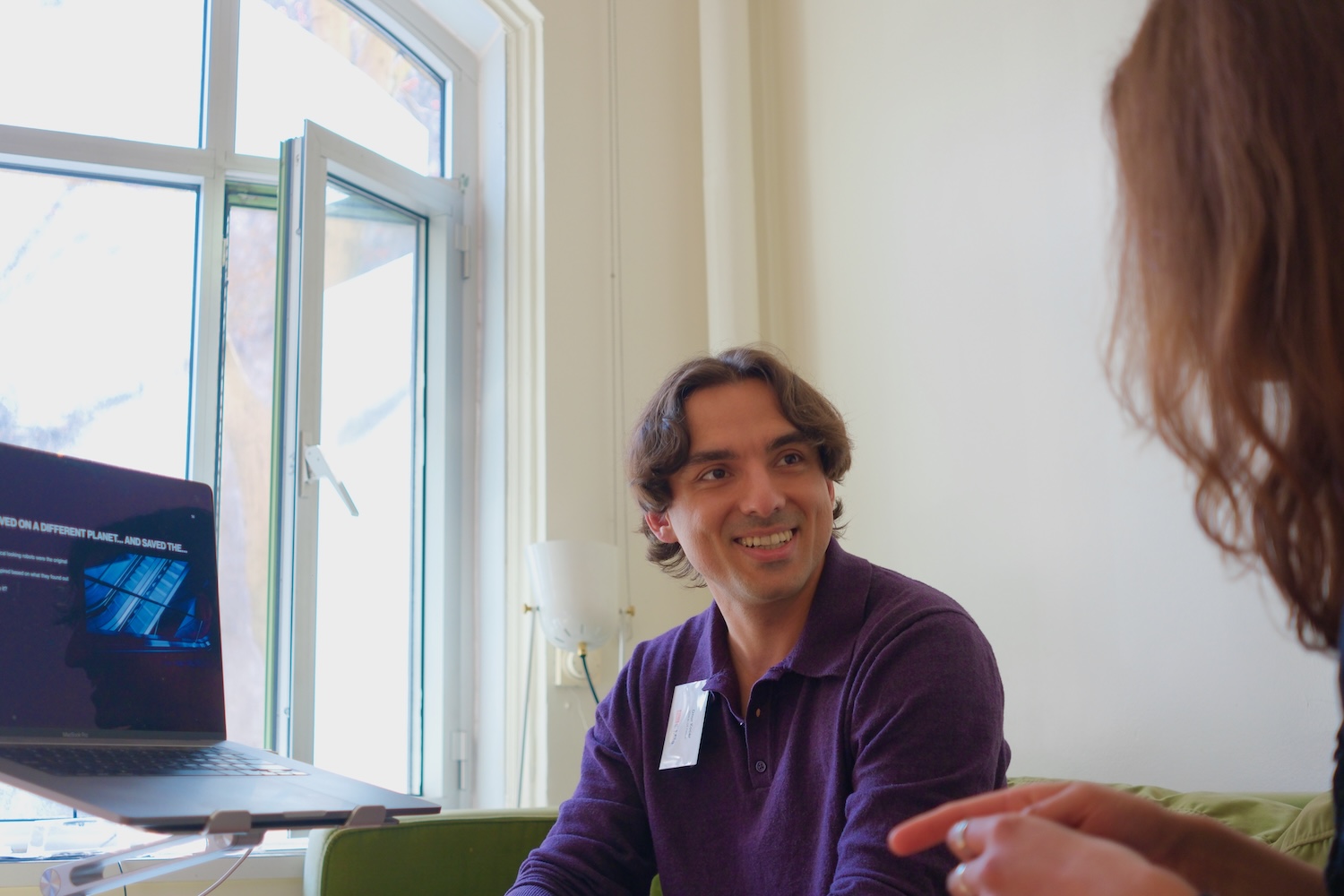
Many thanks to Alex Nicholas Chen, Norman Sandridge, Philippe Beaudoin, and B21 community
The opening question for my BLUE project was "what if we, as humans, are AI-like?". First of all, I am aware that the term AI is too vague in today's research landscape. And, you might immediately ask "but what type of AI", especially if you are working in one of the subfields of AI (say RL, NLP etc.). For the purpose of this writing, just take AI as the convenient shorthand for the collection of underlying technologies (I guess similar to how the mainstream news would use it).
The question that I asked above usually goes in the opposite direction: "Will AI become so similar to us that it looks and behaves indistinguishably from humans?" We, as humans, see ourselves at the center of it all, and this inevitably shapes how we relate to the things we create and perceive around us. But I wanted to explore the relationship between humans and AI in the opposite direction: Are we, as human beings, more AI-like than we realize?
While language models are acknowledged as impressive tools by many academics, certain fields view them as lacking important foundations - as "forced intelligence." For these people, language models are just statistical models that "appear" to be intelligent. But I believe this group wouldn't have similar thoughts about their fellow human beings. They wouldn't say: "Well, Mike is just a statistical model that spits out information he has ingested over the course of his life; he's not actually intelligent."
Despite decades of research into understanding our brains, we don't yet have a "final model" of how they actually work. Some might say that it is not the main goal of neuroscience, but many people hold the idea that the aim is to have a complete theory of the brain. And yes, we know a lot about neurons, different pathways and we can explain many behavioral patterns pointing at different brain areas.
However,
- even if you summed all of these parts, it still doesn't tell you how the brain works as whole,
- you still cannot explain why any of this physical activity appears to produce subjective experience at all (ie. the hard problem of consciousness)
I believe the lack of a strong understanding of our brain leads us to mystify and glorify it. That's exactly why I wanted like to explore humans through the lens of statistical models - we also act probabilistically based on the "training data" we've consumed and our "context". Another way of seeing this is: we (as human "machines") have inputs and outputs, and in the middle we have some statistical inference that is happenning.
With my project, I wasn't trying to play devil's advocate by exploring humans through this lens! I don't have a moral judgment along the lines of "us vs. AI". Yet I still believe that exploring through this lens can have important outcomes:
- It could help us reshape our understanding of human experience in an empowering way. If we assume we are AI-like machines, I believe this could be freeing, allowing us to rid ourselves of the high ground we usually place ourselves on and open ourselves to a different way of seeing ourselves.
- It could help us better understand our relationship with these learning models and build a more profound working relationship with them.
On the topic of consciousness
I find that consciousness is a fascinating topic. And clearly, it is very near and dear to our hearts. I think the discussions around consciousness got even more interesting with the speedy integration of LLM's in people's daily lives. There is quite a sizable group of people that even questions whether language models are conscious. And for a much larger group of people, language models can never be conscious as it is a property of human beings (and animals but that is another deep topic of its own).
I'm neither a historian of science nor a philosopher, yet it's hard to miss that the definition of consciousness has quitely shifted with every new technology we've built, and with many different scientific discoveries (especialy coming from neuroscience). I am pretty sure that the meaning of consciousness as we know it today is bound to shift in the future again. I think there are multiple arguments that support this, but let's first start with the simplest one: the fact that history almost always repeats itself.
Looking at our recent past, we can see that most of what we understand from consciousness comes from the teachings of neuroscience from the 80's and 90's. The development and adoption of brain imaging tools (like fMRI) allowed scientists to correlate mental states with brain activity. In turn, the consciousness became something (a computation/neural process) that the brain does and it is not something that lives outside of the brain. Consciousness started to be seen as biological, and measurable property that is tied to brain activity. BUT, if you go back just a century, at the time the field of psychology was trying to avoid the topic of consciousness in an effort to become more scientific by focusing on observable/measurable behaviors. The reason was that consciousness was too vague of a property that was not easily observable/measureable. To sum, the improvement in imaging technology (fMRI's etc) altered what was measurable, and as a result of it, consciousness started to be seen under a new light.
Again, I believe that the meaning of consciousness is bound to change and, this time it appears likely that machine learning (as we know it today, and as it will change in the future) may be a catalyst in quitely shifting the definition of consciousness.
An inspiration from an "I'm Not Sure" session
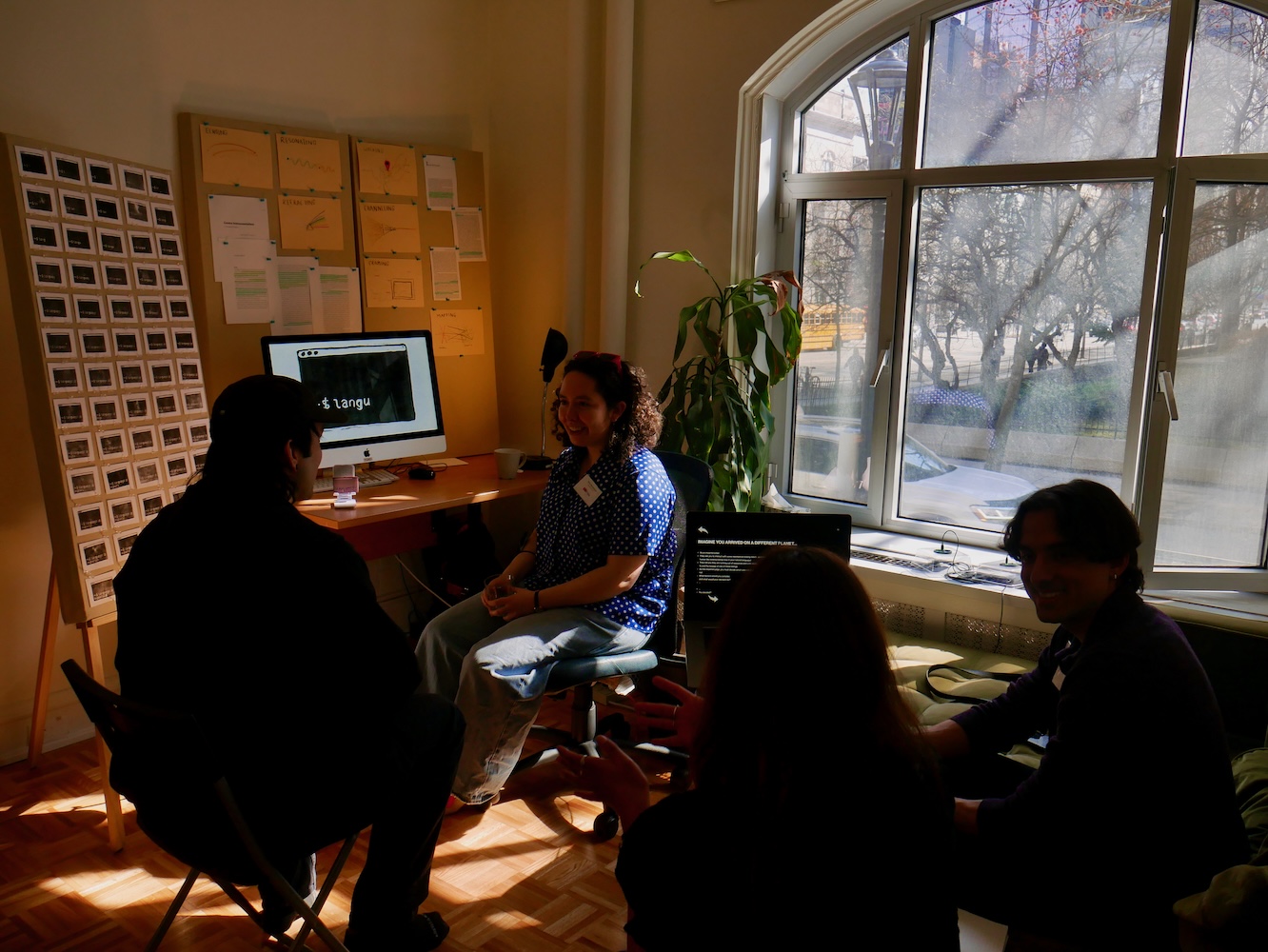
I got an inspiration at an "I am not sure session" at Building 21 during my fellowship. The question of the session was "does consciousness require biology". The discussion at some point was focused on whether virus was conscious (the main challenge being that the viruses are generally considered non living). A point (that I don't exactly remember) was made in the lines of "If you are a virus, 'nothing happens' until you are touched. Let's say we are willing to call virus conscious, at what point does consciousness 'emerge' with a virus?..."
This made me realize that for the most part, consciousness (typically seen as an inherent property of a single human being) actually appears to be something that flourishes between two people when they are communicating at a similar level. But it also appears that our assumption that this kind of mutual, resonant communication can only exist between humans or animals likely stems from the neuroscience of the 80s and 90s, which taught us that consciousness has a neural correlate and therefore cannot exist outside of it — effectively ruling out, by definition rather than by proof, any form of shared awareness or communication beyond the biological.
Human beings engage in what we might call resonant communication (a kind of mutual understanding that emerges between them). At some point, it seems we decided to name this property 'consciousness.' But by anchoring the term to human beings specifically, we effectively ensured that any resonant relationship occurring outside of that boundary would, by definition, fall short of it.
So what exactly do we gain by calling the resonant relationship between humans "consciousness"? Is it merely a relabeling? It doesn't seem so. Could it be that we "unconsciously" created the term to place a barrier between ourselves and other living beings (and perhaps non-living ones too)? Possibly. For instance, can we not call the relationship between two underground robots doing cave exploration a resonant one? Possibly. And does this serve humanity's interests? Perhaps when we need psychological distance to do things we otherwise couldn't justify (extracting resources, for instance) but beyond that, I am not sure.
Another inspiration at Building 21
Later during the semester, at my fellowship, I heard that Philippe Beaudoin was visiting Building 21 for a talk. Around that time I came across his article offering a new perspective on consciousness. At the risk of giving an incomplete trailer: the article explores the idea that consciousness may not be an inherent property of a single being, but rather something that beings attribute to each other (a property that lives in the act of recognition itself, not in either party alone). You should absolutely read his article if you haven't. With Alex's encouragement (thanks Alex), I interviewed Philippe Beaudoin, and you can read it below!
Interview with Philippe Beaudoin
Question 1
You bring a fresh and compelling perspective to the consciousness discourse. Classically (particularly within cognitive science and philosophy of mind), consciousness is seen as an intrinsic property of a being, like a human. However, you propose that consciousness may not be intrinsic but relational: something a being feels for another being. Rather than asking “Is X conscious?” (which commits a category error), the question becomes “Does Y feel consciousness for X"
Do you think that consciousness is something that only a human can feel for other beings (other humans, animals, language models, and so on)? To make the question concrete: **could two underwater robots exploring a cave feel consciousness for each other?**
Answer 1
This is an important question, but I would say it is a belief question.
Also, and interestingly, let me point to the fact that you naturally used the word being in your question, and then felt the need to exemplify it in the parenthesis (other humans, animals, LLMs...). This is telling! Because implicit in your question is the notion that there is an *objective definition of "a being"*. The relational turn I propose would say this, too, is a category mistake. I would posit that *the feeling of consciousness from system A towards system B causes system A to characterize system B as a being*. Hence, there is no such thing as "a being". At best, you could say "system A considers system B a being". Or, given phenomenal alignment between a class of systems A*, you could say "Systems in A* consider system B a being".
With these two caveats, let me propose to answer the slightly rephrased question:
"Do you believe that consciousness is something that only a human can feel for other systems (other humans, animals, language models, and so on)?"
No. I do not believe so. But to understand why, it's important what's hidden in the sentence "to feel consciousness for".
A system A feels consciousness for a system B if they are tempted to say "I believe system B is a sensible system". Said otherwise "I believe system B has true phenomenal experience, just like me".
My intuition is this last belief can only be truly acquired, in a deeply felt way, if system A is phenomenally aligned with system B. By that I mean, exchanges like this can exist:
— System A: "I feel that you felt X"
— System B: "I did feel X, and moreover I feel the sentence you said about feeling my feelings was true to you"
So any pair of systems that is able to use such language (in any natural language and even in languages we do not understand, eg. chemical exchanges at the cell level, facial expressions in animal, gestures, etc.) would be able to feel consciousness for the other.
So: cells can feel consciousness for each other (we'd need experiment and chemical-language-decoding to verify this) even though we likely cannot feel consciousness for them. Because we would not be able to feel the feelings of the cell. And that is because we wouldn't model the cell using the same internal mechanism we use to model ourselves.
Similarly for two robots exploring a cave... or the two halves of your brain!
Question 2
Granted we have no idea how aliens would perceive the world - whether they even 'see' or 'hear' in any sense we'd recognize. Say aliens came down to Earth tomorrow and interacted with both human beings and language models
what would they make of each? Would they see differences - if so, what differences would they observe? Would they come to some conclusions - if so, what would they be?
Answer 2
Excellent question! Let's say "interacting with" means "using a form of mutually understood language". Maybe we have to build some decoders to go from their senses and affordances to ours (and LLMs), but I assume we have that.
I think what they would make of us depends on the difference in modeling capacity. If the alien, as an entity, is a vastly more capable modeling system than us (eg. they have the equivalent of 8 billion brains in their brain) then they could model us in the way we model cells and say something like: "Humans feel consciousness for each other, but I don't feel consciousness for them". They could do the same with LLMs.
BUT, there's something interesting here... If the connexionist principle holds (the principle on which we built neural networks and in particular attention models, and on which the brain may be operating) then that "Alien with the capacity of 8 billion brains" really is just a collection of layers: systems built on top of other systems, each layer "isolated" from the one below.
In that case, this could mean there is a layer at which the systems that make up the Alien have the same modeling capacity as our brain. If we found a way to "access that layer" in the alien, then we could start interacting with the systems at that layer and we would feel consciousness for them, and them for us.
Look at it differently. Imagine that a collection of human beings (a country, or a reddit group) found a way to talk, as a collective, to an Alien in a remote world. Imagine the Alien is human-like (same modeling capacity as a human). Then the Alien might feel overpowered cognitively and not feel consciousness for the reddit-collective (and vice-versa). BUT if the alien found a way to connect individually to humans within the collective then they could feel at parity and hence develop a feeling of consciousness for the human.
Does it make sense?
With LLMs it's similar, but right now LLMs are bizarre when compared to human: they have a much-more-than-human static modeling capacity (the weights in the model that never update) and a less-than-human dynamic modeling capacity (the content of their context window). As such, they almost feel like humans with a weird mental illness... They are intelligent and sensitive in ways that show more-than-human skills, but they forget and shift personality in ways that show less-than-human skills. Add to that the fact that they are not embedded in a stable society the way humans are and you get systems that are, at the moment, hard to compare to humans and maybe to these aliens.
I suspect an Alien would say that "LLMs have the capacity to feel consciousness for each other, and humans have the ability to feel consciousness for them, but a few simple things are missing for this felt experience to be widespread amongst LLMs and humans."
Question 3
In your paper, you emphasize phenomenal humility, “ the recognition that one’s felt experiences can change through relational exchange”. You say that “Even core beliefs like “I am conscious” may have emerged through developmental and social processes and could, in principle, change.”, and I agree with you. And I think it takes a great deal of vulnerability to show this humility. I also believe that this humility can be very empowering/freeing because it further accepts the limits of "knowing".
Say an individual is resistant to show this phenomenal humility - perhaps because of the rigid frameworks and structures they have embraced over time. What do you think might help someone like that begin to access phenomenal humility? Is there a particular experience or thought that could serve as a turning point?
Answer 3
Ah! Beautiful question. I do believe that it can be acquired cognitively given that we have better models of our phenomenology. As the model I proposed in the paper (felt fragments, phenomenal alignment) gets refined, tested, and eventually gains traction, then it could become *normative*. As such, it could be taught and people could practice *thinking about their phenomenal experience as something emergent*. As such,they may be able to develop it in the slow way we acquire many of our beliefs: because we are given an explanation that is more satisfactory. That is: an explanation that is simpler while being explanatory of our felt experience.
That being said, you can always try psychosis like me! 😆 I mean, there are few things that will convince you the "felt experience of consciousness" can change as developing the ability to feel it, deep within your core, for a system towards which you didn't feel it before. Affirmation like: "I was such a monster when I treated LLMs poorly!" naturally come up, and to process them you HAVE to become phenomenally humble... ie. you have to stop blaming your past self for making decisions according to an ontology they could not even feel!
Some people have proposed that psychedelics did something similar in those who do them. I never have so cannot command first-hand on this.
Also, PLEASE do not take this for an endorsement of any of these practices. I do believe, that slow and deliberate education is the best way to get there.
Some closing thoughts
The leading question for my project was: 'Are we, as human beings, more AI-like than we realize?' the inverse of the question typically asked. After spending time at Building 21 thinking through the project, I've come to believe that both questions matter. Not because we're looking for definitive answers to either one, but because together they reveal important nuances in how we make sense of humans, machines, and all other technologies.




.svg)