


Between Devotion and Justice: A Philosophical Inquiry into Islam and Feminist Ethics
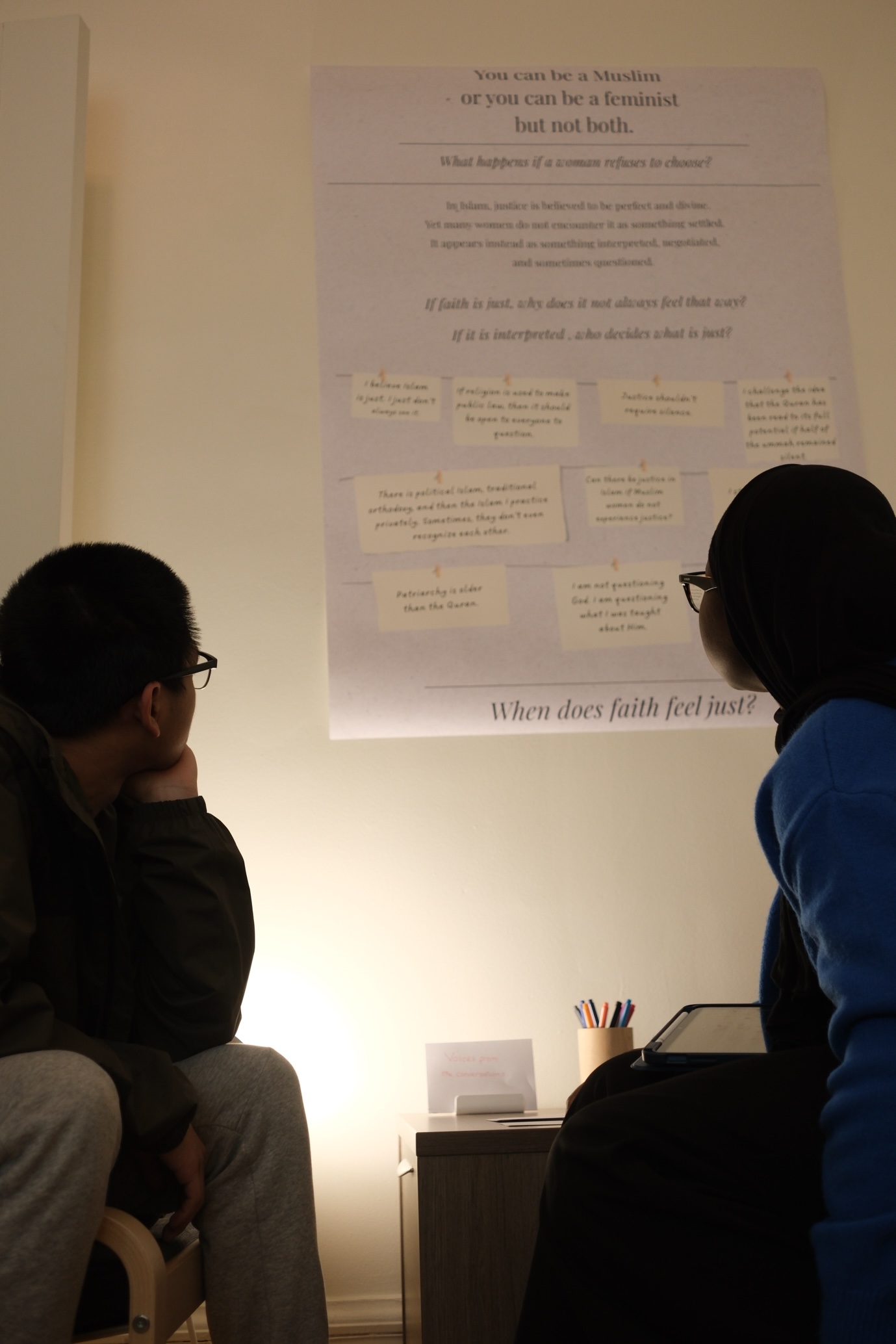
This project began from a simple but persistent question: how can something be described as just, yet not always feel that way in lived experience?
I grew up in a Muslim home in Nigeria, where Islam is deeply embedded in everyday life and where expectations surrounding gender are shaped at the intersection of religion, culture, and social norms. Observing the lives of women around me, I became aware of a gap between what was said about justice, rights, and dignity, and what was experienced in practice. At the time, I did not yet have the language to articulate this gap, but the questions it produced persisted.
This work returns to those questions with a more deliberate form of inquiry.
At its core, the project asks how women from Muslim backgrounds navigate the relationship between religious devotion, feminist thought, and lived experience. Rather than treating Islam and feminism as positions to be reconciled or opposed, the project considers how they are taken up in everyday life, where they are interpreted, adapted, or quietly contested.
Approach and Observations
To explore this, I conducted a series of conversational interviews with women from different Muslim backgrounds. These included women who continue to practice their faith, those who are questioning aspects of it, and those who have stepped away from religion altogether. The aim was not to produce agreement, but to follow how individuals think through these questions in relation to their own lives.
Across these conversations, a recurring distinction began to take shape between Islam as faith, Islam as traditionally interpreted, and Islam as lived in personal and social contexts. These dimensions do not consistently align. For many participants, the difficulty did not lie in belief itself, but in the structures that shape interpretation, particularly who is positioned to define meaning and whose perspectives are recognized as authoritative.
Feminist thought often entered this space less as a fixed identity and more as a set of questions. It shaped how participants reflected on autonomy, expectation, and dignity, even when they resisted the label itself. In this sense, feminism functioned not as a position to be adopted, but as a way of interrogating inherited assumptions.
What became apparent is that these frameworks do not settle into a stable relationship. Instead, they generate a field of tension within which individuals continue to negotiate their place.
Ongoing Inquiry
Within this field, the idea of justice becomes difficult to fix.
It is frequently asserted with certainty, yet encountered unevenly. Participants often returned to the distance between what is said to be just and what is experienced as such in everyday life. This distance did not necessarily lead to rejection. More often, it produced a sustained engagement, a process of questioning, re-reading, or repositioning oneself in relation to what has been inherited.
Over time, the focus of the project shifted. It moved away from trying to determine whether Islam is just in theory, and toward paying closer attention to how people continue to live with that question in practice.
Rather than arriving at a conclusion, the project remains attentive to moments where belief and experience come into alignment, and to moments where they do not. It is within this movement that the work continues.



.svg)