


The Eroticism of Self-Discovery: A New Theory of Digital Identity
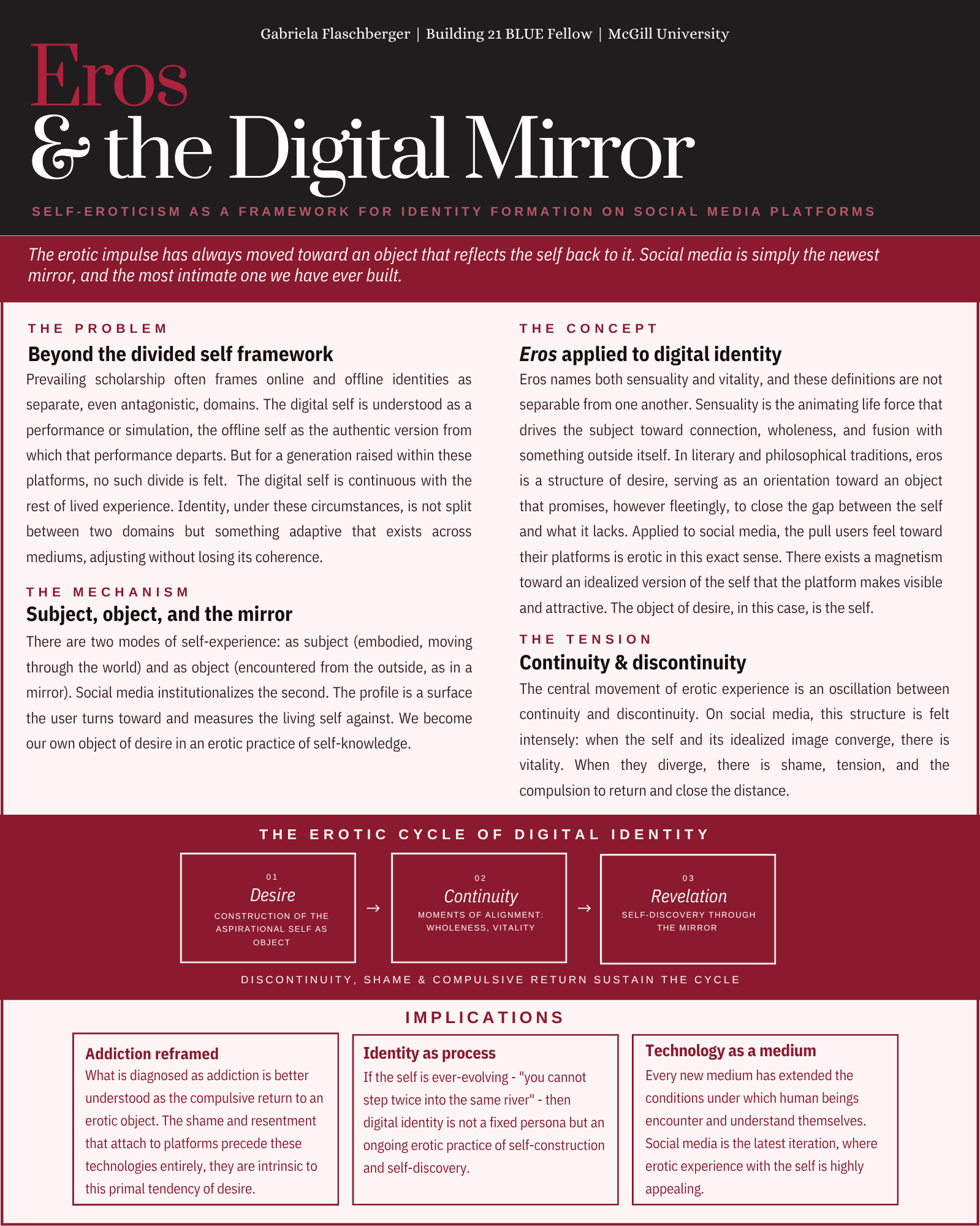
Eros & the Digital Mirror explores social media as a space where young people encounter themselves as objects of desire, reflection, and self-knowledge. Rather than understanding social media use only through dominant frameworks of addiction, narcissism, or performance, this project uses the concept of eros as a drive toward connection, vitality, and self-discovery. I argue that digital profiles function like mirrors: users construct idealized versions of themselves and seek recognition through them. In this process, the self becomes both subject and object, creating moments of pleasure, discomfort, intimacy, and shame. Ultimately, the project suggests that social media did not invent this desire to know oneself from the outside, but has intensified it, making the digital self a constant site of longing and reflection.
The Intellectual Process
The project did not begin here. Its initial focus was narrower and more descriptive: an analysis of curated consumption patterns on social media, examining the ways users attempt to organize and aestheticize their digital lives in order to make them feel more intentional and less guilt-inducing. But the deeper the inquiry went, the clearer it became that the guilt itself was the more interesting issue, and that the frameworks being used to explain it were not adequate to what they were describing.
The dominant narratives around social media share a common assumption: that there exists a real, pre-existing self and that digital platforms either corrupt or distort it. The online self becomes a kind of false consciousness. However, for anyone who grew up with these platforms, this account does not map onto experience. The divide between who you are online and who you are offline is simply not a felt distinction for most digital natives. Identity does not live in one place and visit another. It is formed continuously, across every medium you move through, and social media happens to be a crucial site of this self-formation.
The theoretical pivot came through reading philosophical and literary analyses of eros. Across these analyses, a recurring structure emerges: the erotic object within literature always exceeds its physical form. It functions as a mirror, a vessel that satisfies the subject's inner libido for self-discovery. The protagonist's obsession reveals less about the object itself than about the contours of the self doing the desiring: about lack, longing, and what the self reaches toward when it reaches outward. The object becomes the medium through which self-revelation becomes possible.
Social media operates according to precisely this logic. When a user curates a profile, crafts a self-presentation, builds an aspirational self, they are producing an object that they then turn back toward and desire. The subject shifts from experiencing the self as subject to experiencing the self as object, imitating the structure of looking into a mirror. Social media institutionalizes and amplifies this mode of self-relation, which has always been one of the primary routes through which human beings attempt to know themselves.
The framework of continuity and discontinuity, drawn from broader theories of erotic experience, also became central to this analysis. In erotic experience, the subject seeks continuity, or fusion with the object of desire. When that continuity is achieved, even briefly, there is vitality. When the distance between the self and the idealized self becomes visible, discontinuity emerges, producing feelings of shame, resentment, and inadequacy. Most importantly, this rupture does not end the attachment. Rather, it produces the compulsion to return and close the gap once again.
This dynamic closely resembles the experience of social media engagement. The compulsive checking, the discomfort of misalignment, the oscillation between satisfaction and inadequacy, and the guilt attached to one’s own digital behaviour are not just symptoms of addiction or narcissism. What the eros framework offers is an account of the hope inside the compulsion. The return is not merely behavioural. It is erotic, driven by the belief that the object might satisfy our insatiable need for self-discovery, making the self more legible to itself.
The Showcase
For the showcase, I built a chamber of reflection, a small storage closet transformed into an intimate, private space where visitors could sit with the project's central questions and contribute their own responses. The room held two mirrors facing each other, producing an infinite series of reflections, a deliberate visual argument that the self is never singular or fixed, but something that shifts depending on the angle from which it is encountered. A soft pink ambient light cast the space in something between introspection and warmth. I closed the door behind each visitor, leaving them alone with a set of anonymous prompts.
When you look at your own profile, do you recognize yourself?
If the digital version of you disappeared tomorrow, what would be lost? Would it be missed?
What does your profile say about you that you would never say out loud?
I deeply appreciated the responses and was glad to see that my theory resonated with many participants. The installation became the theory made physical: the encounter with the self-as-object is not something social media invented, but something it has intensified and turned into a constant condition of everyday life.
Eros & the Digital Mirror began as an entirely different project. Throughout my time at Building 21, it pivoted into something I believe is more necessary: a challenge to the conventional narratives that have dominated conversations about social media use, and an attempt to offer a language for an experience that has long deserved more than shame. This work would not exist in its current form without the peers and mentors who shaped it at every stage. Thank you to everyone at Building 21 for creating the conditions in which ideas like this one can take root and grow.


.svg)