



Inner Diaspora: Does diaspora depend on transnational migration?
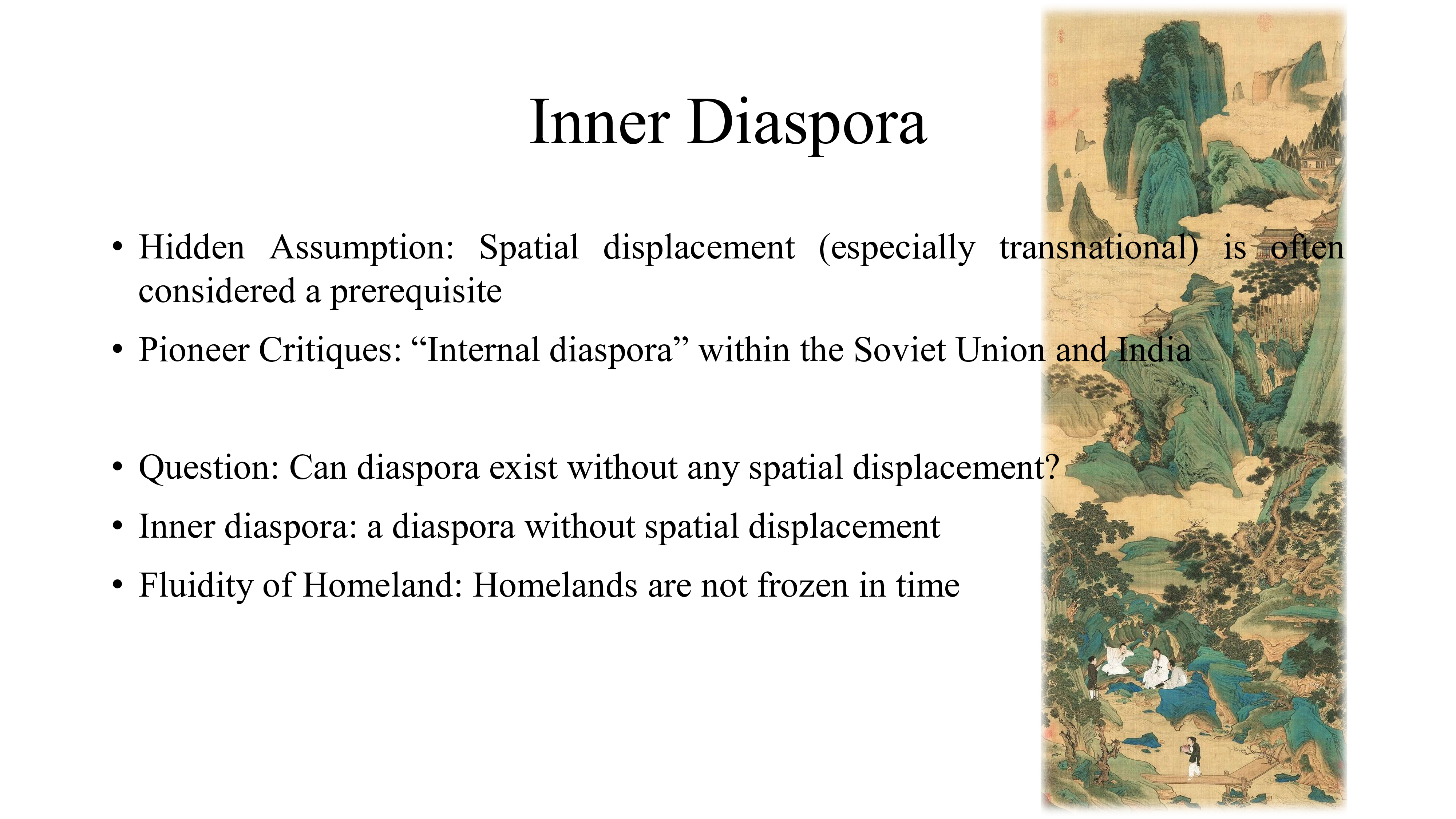
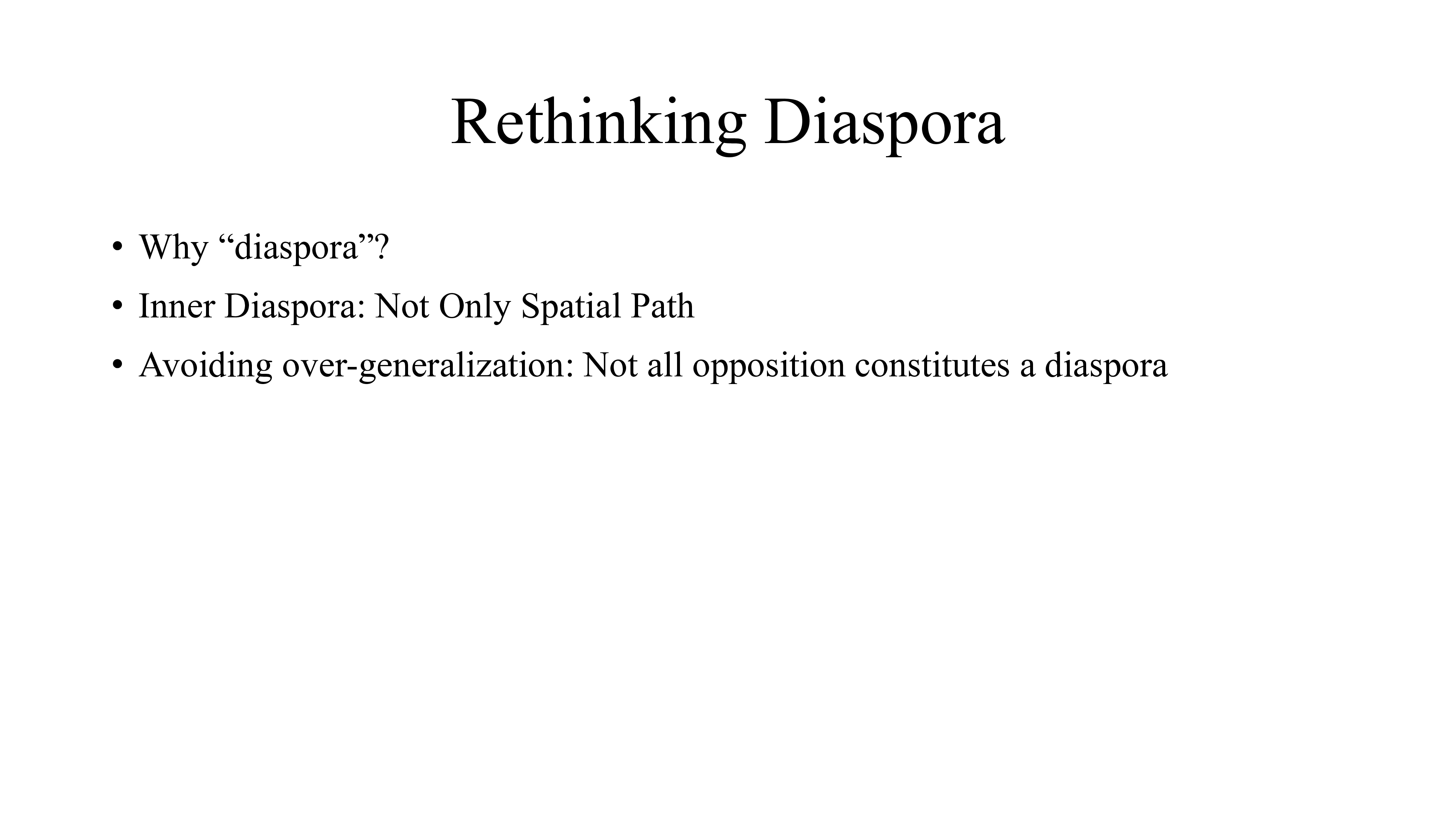
Classical diaspora theories have long been associated with geographical mobility, particularly movement across national and cultural borders. My project seeks to decouple “diaspora” from “migration” by proposing a theoretical shift toward the concept of “Inner Diaspora.” This concept captures a condition of identity alienation produced by the friction between global discursive influences and the accelerating de Westernization of national narratives in non-Western contexts.
Viewed through the lens of contemporary Chinese youth, rapid social transformations can compress generational change into a single historical moment. This process pushes non migratory populations, especially those who grew up shaped by globalized imaginaries, to the margins of their own culture, now increasingly dominated by nationalist discourse.
It is not that you immigrated, but that the ground beneath your feet moved, leaving you a stranger in your homeland.
A Homeland of the Mind: Mapping Inner Diaspora
Overview:
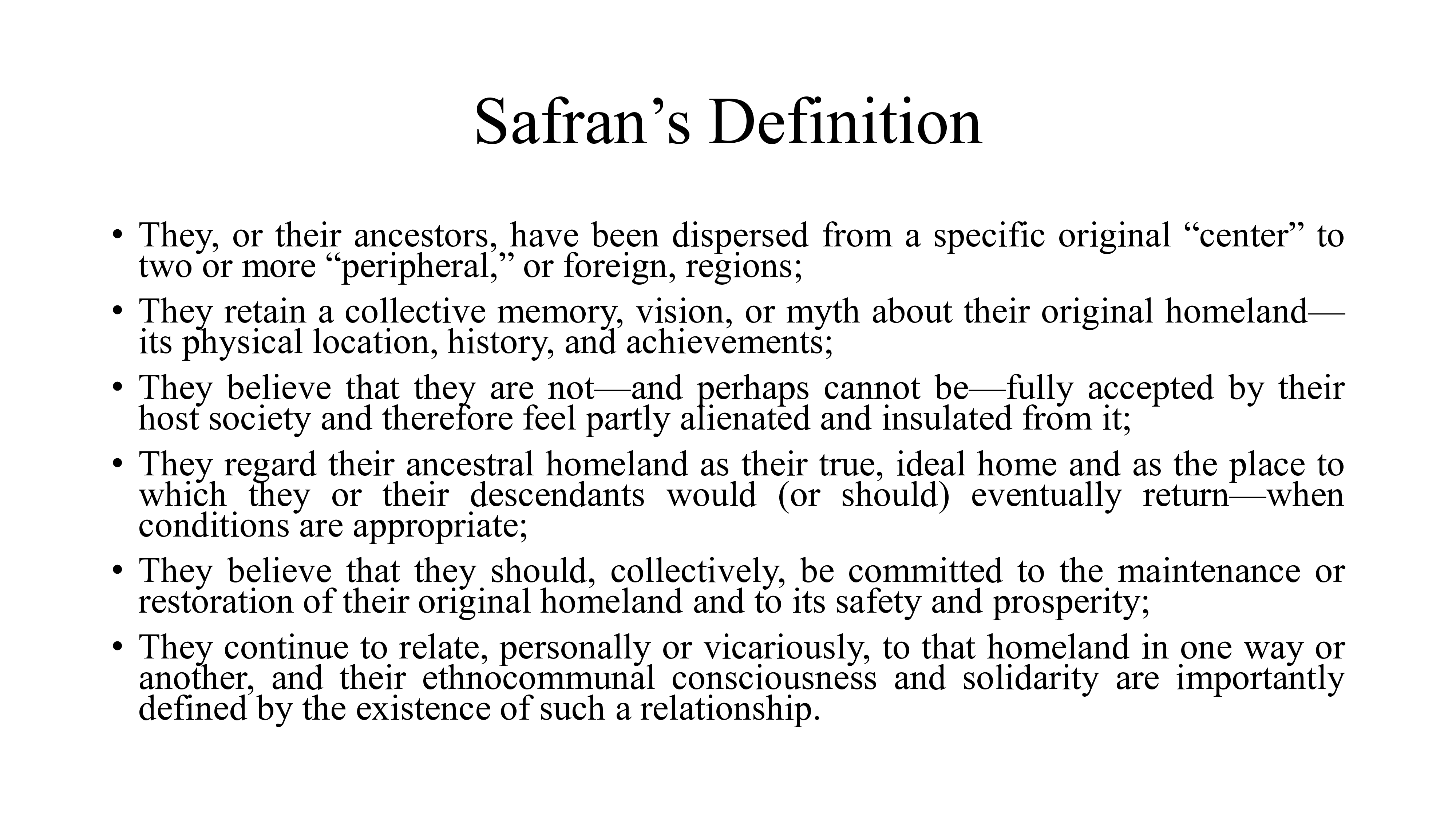
Classical diaspora theories often focus on immigrants to the West, overlooking diaspora-like conditions that emerge in other regions and among non-migratory populations. To address this gap, this research proposes the concept of “inner diaspora”. Drawing on William Safran’s classical criteria, it revises diaspora theory by discarding spatial displacement as a necessary prerequisite. The concept refers to a state of identity alienation that arises from sustained tension between globalized discursive imaginaries and local mainstream narratives, even in the absence of transnational movement.
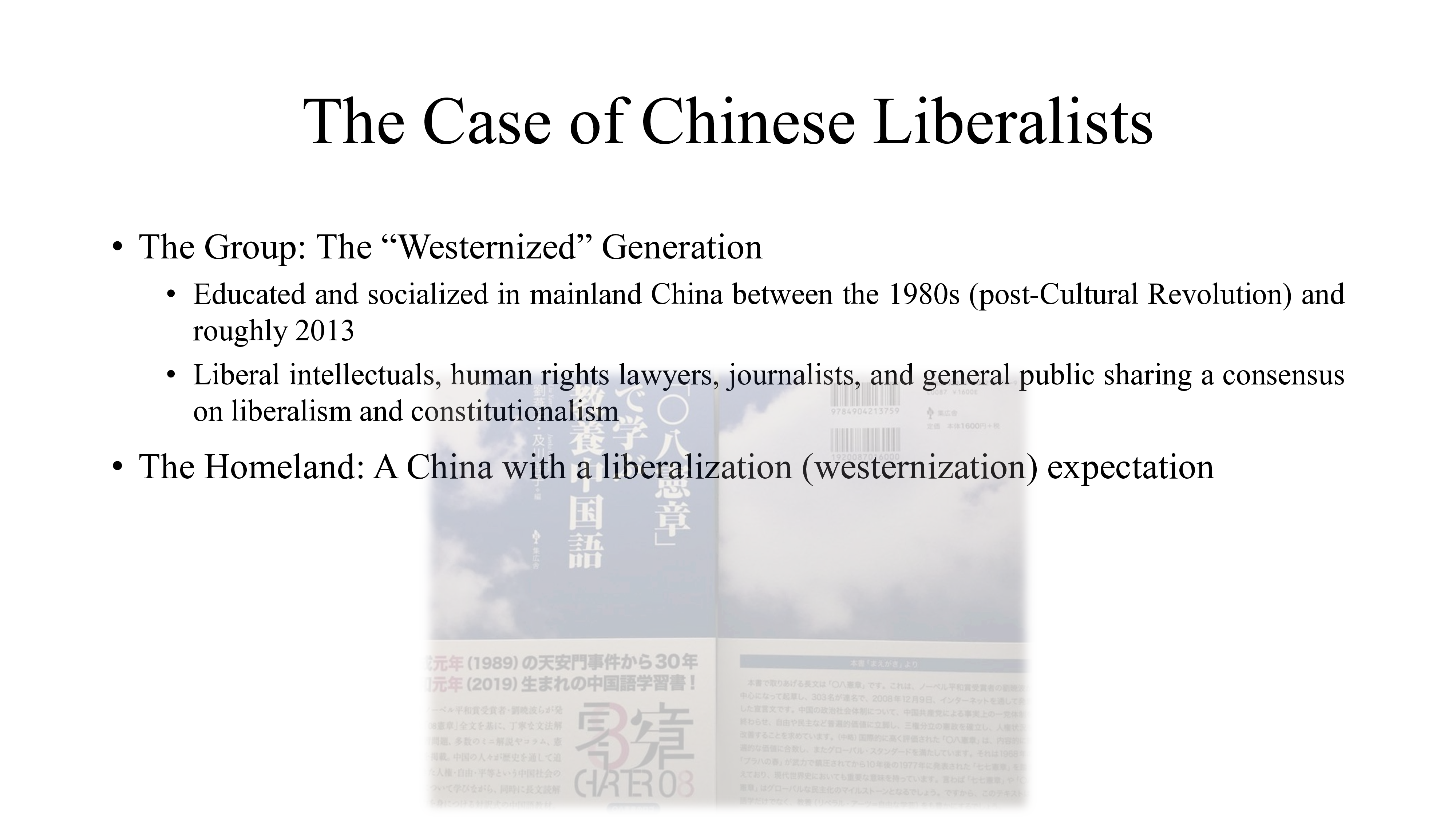
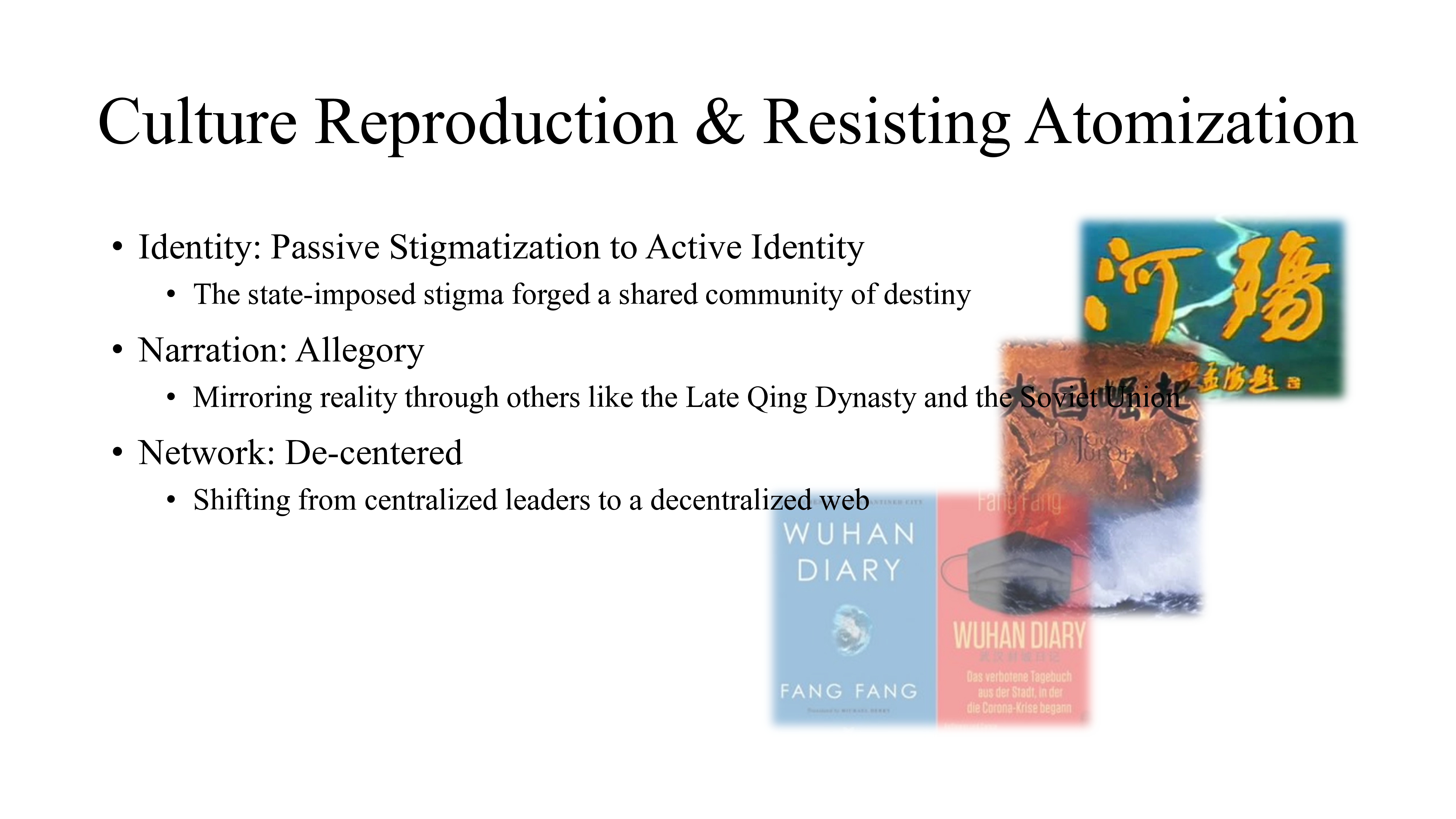
The analysis centers on a generation in mainland China influenced by Westernization, who now face rapid de-Westernization. Caught between former Westernized imaginaries and dominant nationalist narratives, these individuals face intensive social control and rising societal populism. Unable to integrate into the cultural mainstream, they are systematically marginalized and pushed into an “inner diaspora,” becoming strangers within their own homeland. Ultimately, this researchnot only provides a Southern epistemological analytical framework for understanding identity dilemmas among non-migratory populations in the age of globalization, but also contributes to the renewal of Southern epistemology itself.
Presentations & Publications
Accepted Conference Presentation
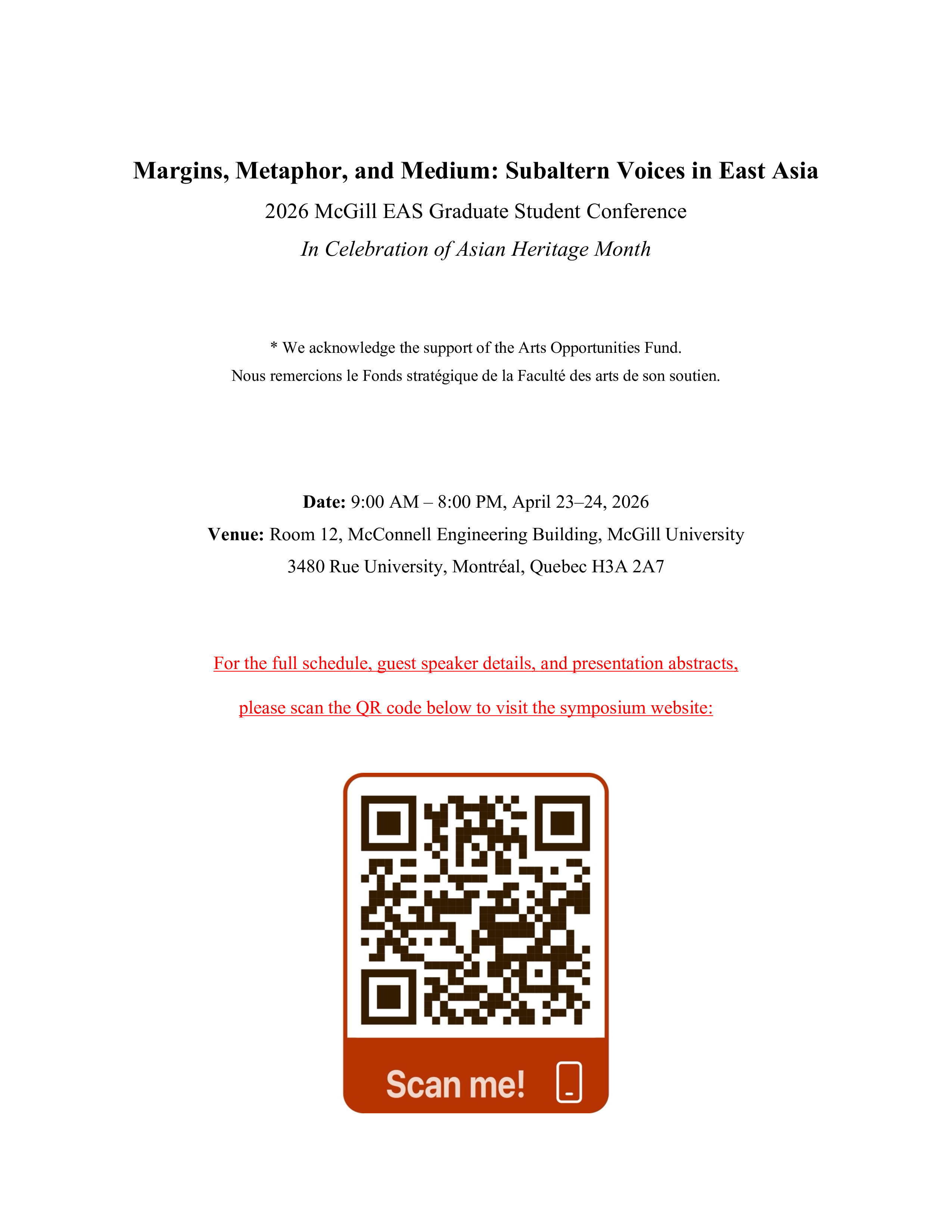
McGill EAS Graduate Symposium: Margins, Metaphor, and Medium
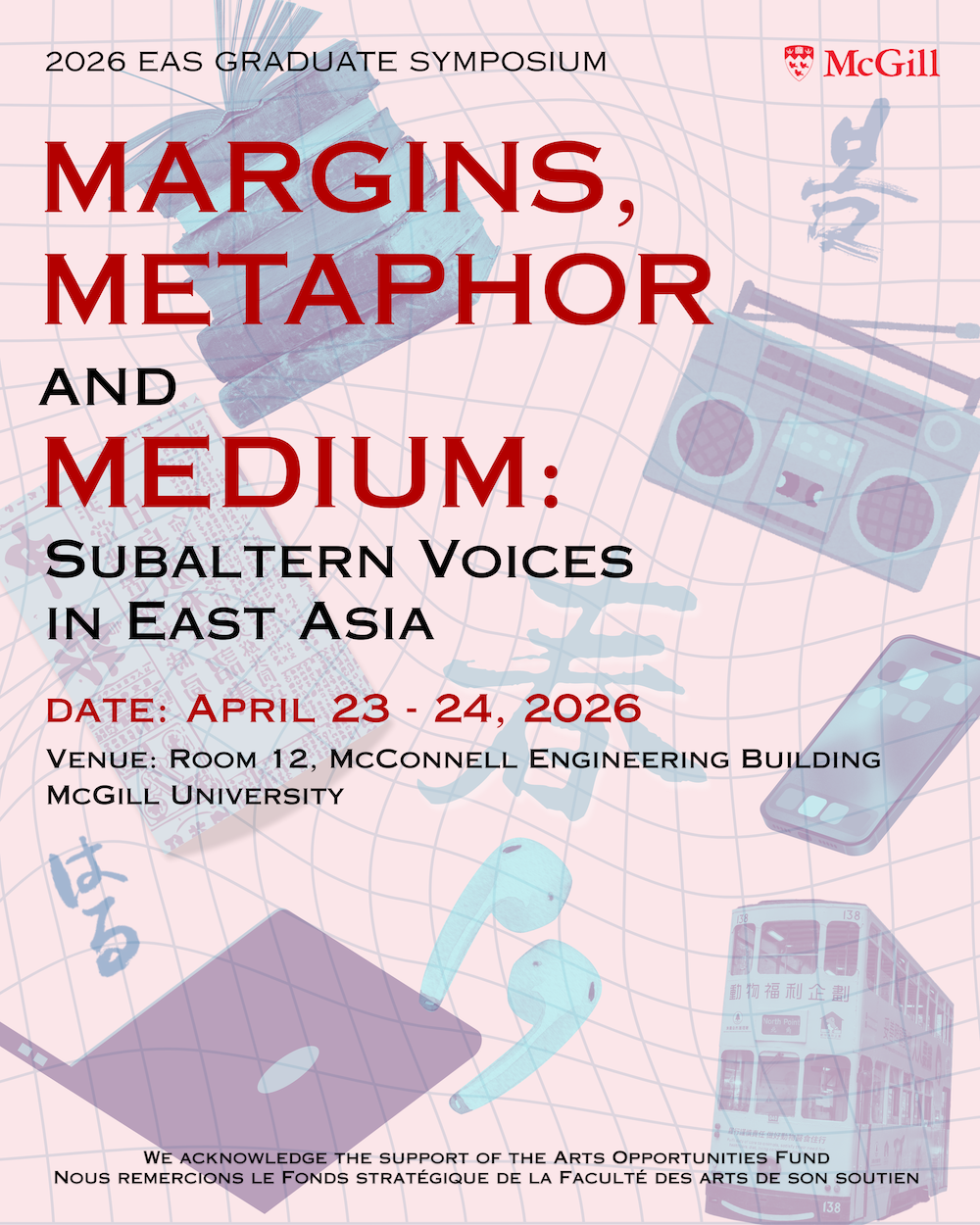
• See below for presentation slides (Appendix 1)
• See below for agenda (Appendix 2)
Related Public Commentary
• https://www.zaobao.com.sg/forum/views/story20260202-8257613=12002589
• https://opinion.cw.com.tw/blog/profile/52/article/16758
• https://www.zaobao.com.sg/forum/views/story20251017-7674905
Looking Forward: A Southern Epistemology and Practical Concern
Whether through academic frameworks or public commentary, my work is driven by a deep practical concern for those facing marginalization. I call for a shift in the Global South perspective by breaking the traditional binary between “homeland” and “globalization.”
Globalization is often seen as an external force that disrupts local cultures and weakens the nation-state’s traditional homeland. For the westernized group in mainland China, however, globalization itself functions as a spiritual homeland. The generation in mainland China from the 1980s to around 2010s, shaped by Enlightenment thought, was deeply formed by globalization. For them, the globalization is the homeland, while the nationalism is the destroyer. And this leads to a broader question: in today’s nationalism rejuvenation context, how should “anti-Western centrism” be re-evaluated?
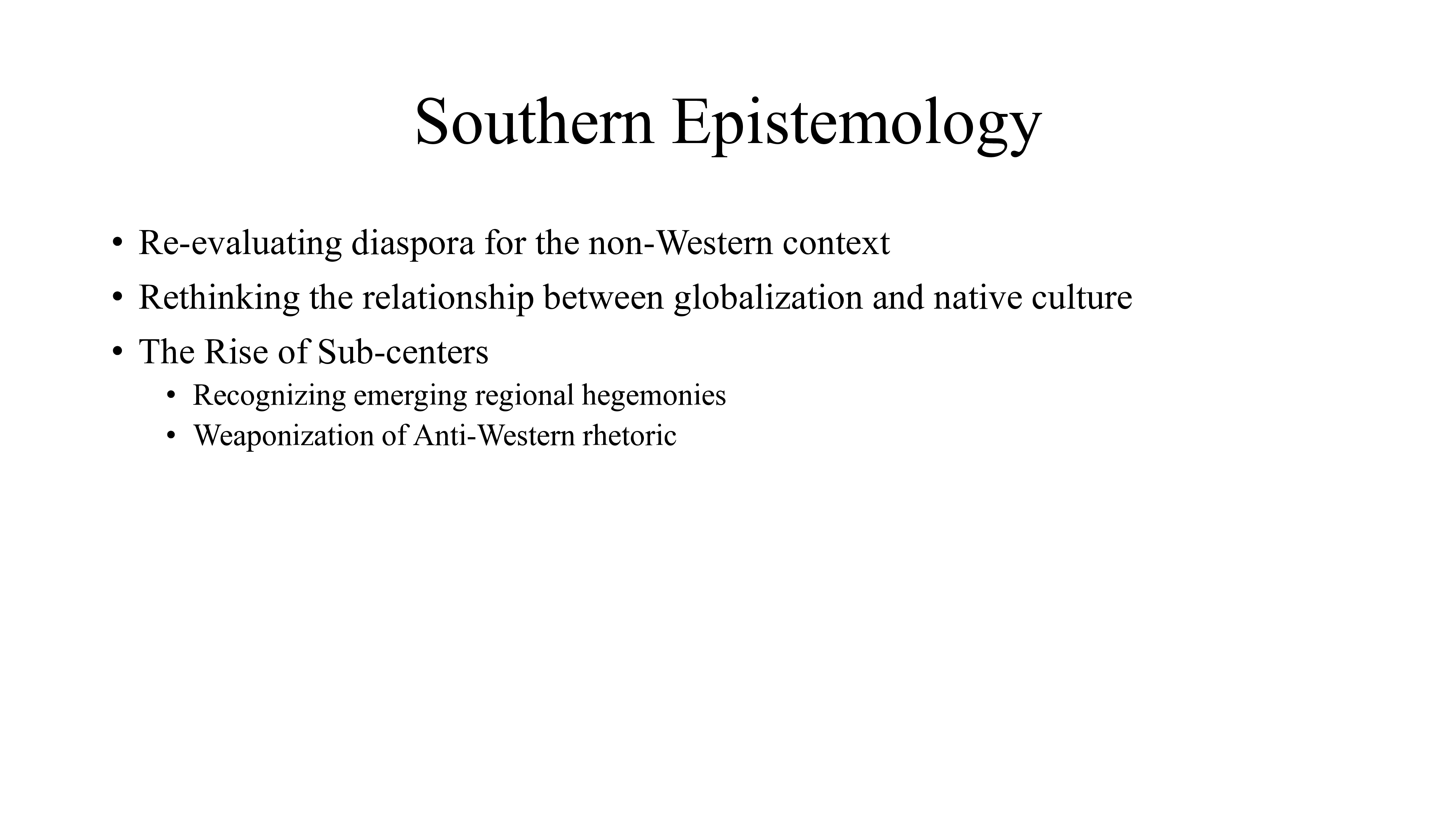
This research argues that although anti-Western centrism has historical rationality and progressive value, its negative dimension has become dangerous today, since the world no longer has a single center. This is the key point of the Southern epistemology proposed here: the Global South itself contains power centers—“sub-centers” subordinate to the Western center.
Paradoxically, these sub-centers appropriate and even hijack anti-Western discourse from postcolonial theory to legitimize themselves, using rhetoric of anti-hegemony and national sovereignty to present themselves as “victims” and “resisters.” Yet once internalized, this discourse becomes a tool for suppressing their own populations.
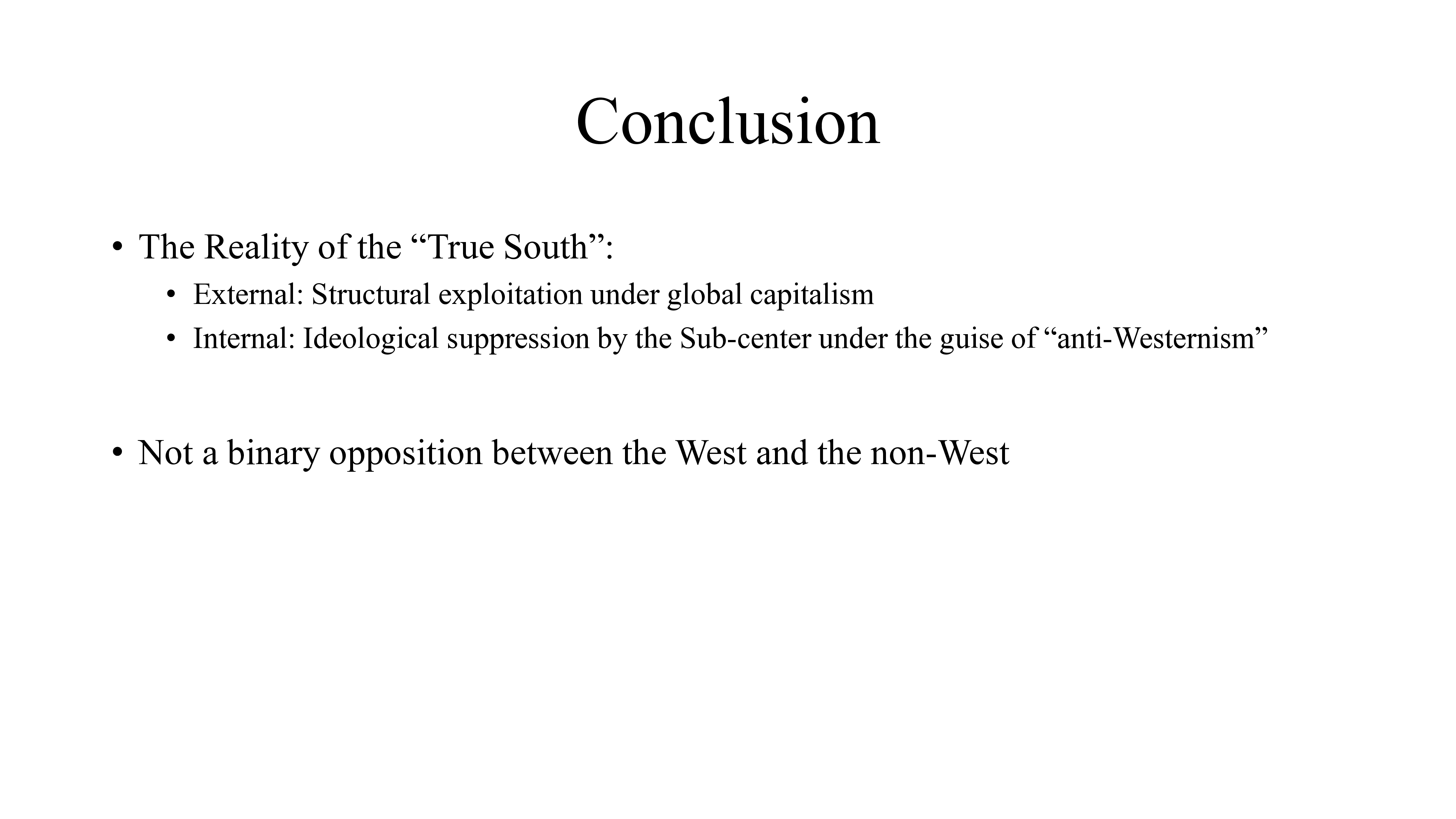
It must be emphasized that this argument does not endorse Western centrism, but advances an “anti–anti-Western centrism” as a double critique. And it thus raises a necessary question: in a global context where opposition to Western hegemony has become unquestioned political correctness in many Global South societies, has this discourse itself become distorted?
I seek to re-evaluate dominant frameworks such as Western centrism, nationalism andglobalization. I believe for a truly emancipatory path, we must move beyond the reductive binary of “West versus non-West,” and instead attend to the complex and shifting configurations of power within and across societies.
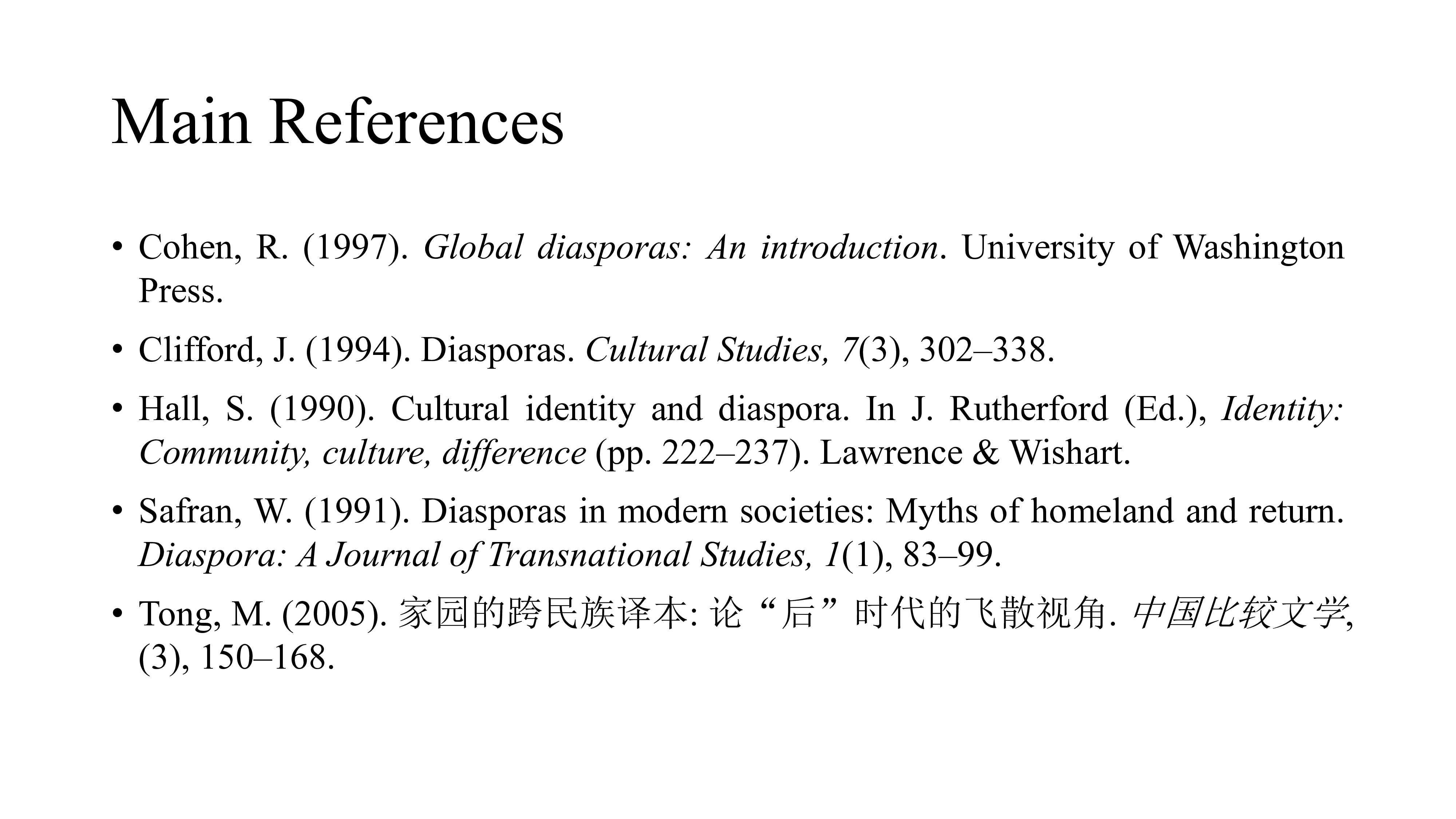
Appendix 1: Presentation for McGill EAS Graduate Symposium: Margins, Metaphor, and Medium



Appendix 2: Agenda for McGill EAS Graduate Symposium: Margins, Metaphor, and Medium


.svg)