



The Linguistics of Control: Language, Reciprocity, and Informal Deterrence
Link to Tamara's website: sites.google.com/view/tamarapressman
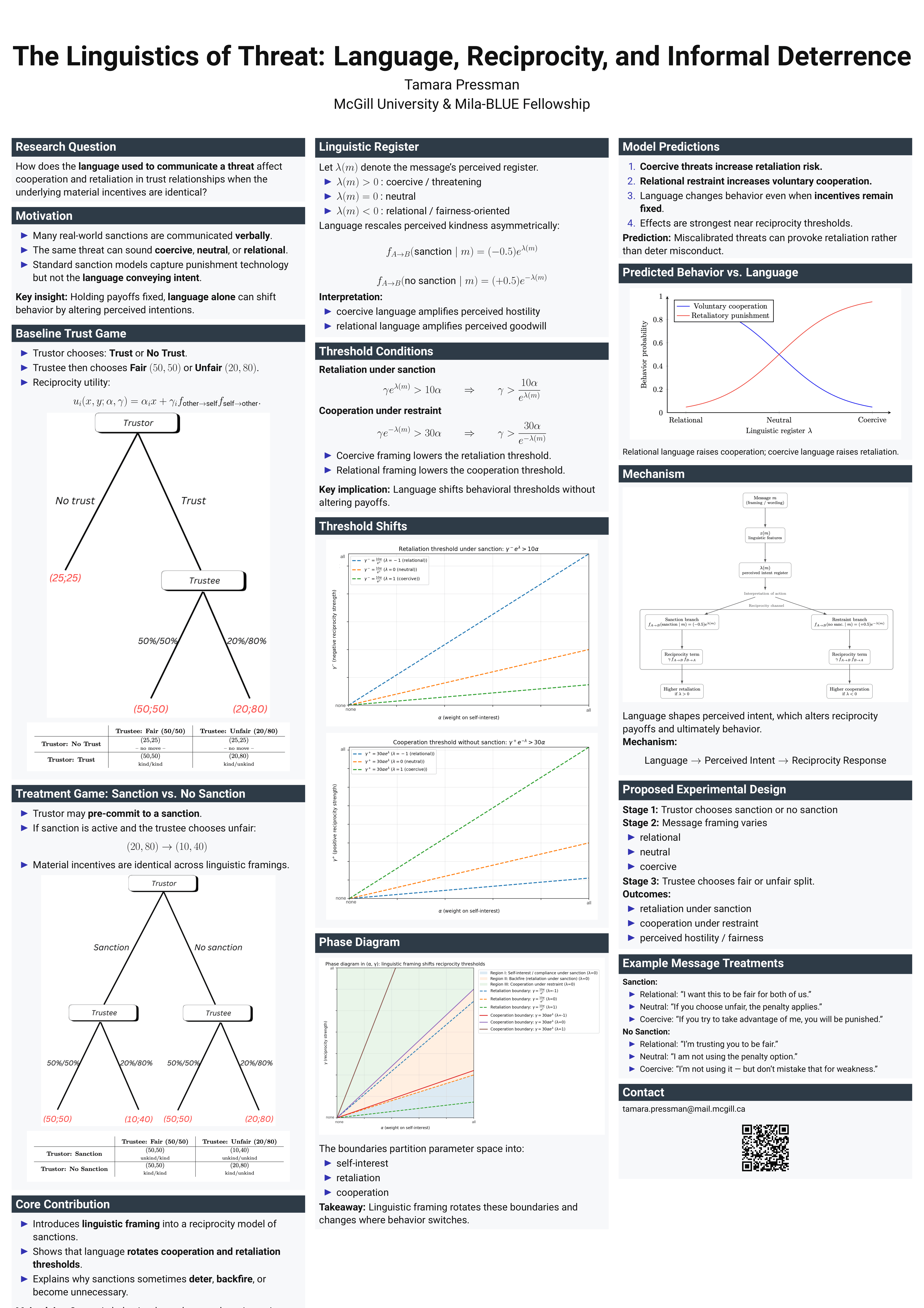
The Language of Control examines how the language used to communicate a threat shapes cooperation and retaliation in settings where formal enforcement is limited. In many real-world interactions—such as households, informal markets, or personal relationships—individuals rely on verbal statements to signal intentions and influence behavior. While standard economic models capture the material structure of incentives, they typically treat communication as irrelevant, assuming that outcomes depend only on material payoffs.
This project develops a formal framework in which language directly affects strategic behavior by shaping how intentions are perceived. Building on a trust game with an optional sanctioning mechanism, the model introduces linguistic framing as a component of reciprocity. Even when material incentives remain identical, the way a threat is expressed can alter how it is interpreted, and therefore how individuals respond.
At the core of the model is the idea that language operates through a “linguistic register,” which captures whether a message is perceived as coercive, neutral, or relational in tone. This register rescales perceived kindness asymmetrically: coercive language amplifies perceived hostility, while relational language amplifies perceived goodwill. As a result, language shifts the thresholds at which individuals choose to cooperate or retaliate, effectively rotating the boundaries between different behavioral regimes without changing the underlying payoffs.
The model yields several key insights. Coercive threats increase the likelihood of retaliation, even when they are materially identical to softer framings. Conversely, relational language can sustain cooperation without the need for formal sanctions. More broadly, the framework shows that miscalibrated threats can backfire, provoking the very behavior they are meant to deter. These results highlight that informal enforcement depends not only on the availability of punishment, but on how intentions are communicated.
Rather than treating language as ancillary to economic interaction, the project positions it as a central mechanism through which power, control, and cooperation are negotiated. By integrating linguistic framing into a reciprocity model, it offers a way to think about how individuals enforce norms and coordinate behavior in environments where formal institutions are incomplete or absent.
Presentation and dissemination
Tamara has presented this work in both academic and interdisciplinary settings. At McGill University, she has shared related research in seminars on behavioural and development economics, with a focus on informal enforcement and cooperation across different institutional contexts.
At Building 21, she presented this project as part of her fellowship at Building 21, using it as a way to think through how communication shapes trust and reciprocity in practice. These discussions helped connect the formal model to broader questions about how people interpret intentions, respond to perceived fairness, and navigate uncertainty in everyday interactions.
In many ways, the project developed through these conversations as much as through the model itself.


.svg)