


In Sync
I came to this project because I kept bumping into a gap: between what women knew about their own bodies, and what science was willing to confirm. That gap is not a failure of the women doing the knowing. It is a failure of the questions we have been willing to ask. And it is not accidental. It is not neutral. It is a choice that gets made, over and over, about whose experience counts as evidence.
In 1971, a twenty-three-year-old undergraduate at Wellesley College noticed that her body and her floormates' bodies were moving in time with each other, in the specific, private, cyclical rhythm of menstruation. She wrote it down. She designed a study. She published it in Nature, and it became one of the most cited papers in reproductive biology. She was a student. She noticed something in her own body and had the audacity to believe it was worth a question. Nobody had thought to look before, or nobody had thought it was worth looking at.
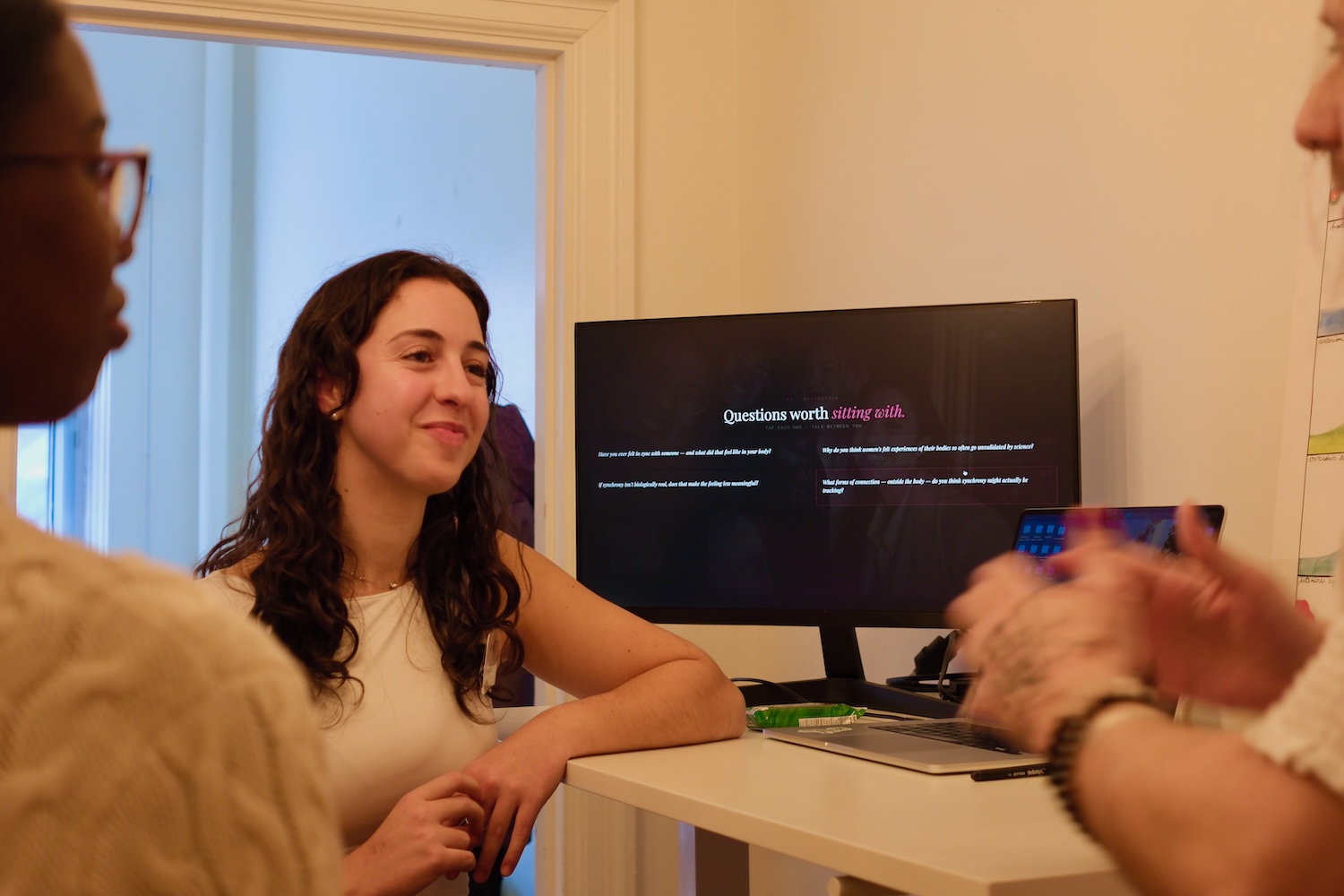
Presenting In Sync at the Mila–Building 21 Scholar Exhibition, 2026. Photo: Alex Nicholas Chen.
What followed was fifty years of the field trying to make the feeling go away. Studies proposed pheromone pathways. Reanalyses said the statistics couldn't rule out chance. Systematic reviews concluded there was more reason for doubt than acceptance. The largest study to date, 360 women tracked by app, found no synchrony at all. Each wave arrived to settle it. None of them did. The science kept saying: probably not. The body kept saying: but I know what I felt.
What this body of research reveals is not that synchrony has been disproven. It is that it has been poorly asked. Studies that failed to find biological synchrony found something else instead: that believing you are in sync with someone, that feeling of moving in rhythm with another person, produces documented increases in empathy, attunement, and connection. Regardless of whether cycles converged. The felt sense is real data. The question was never whether women were right to notice. It was whether anyone was paying careful enough attention to see what they were noticing.
The research lives in what you already know. The science is trying to catch up.
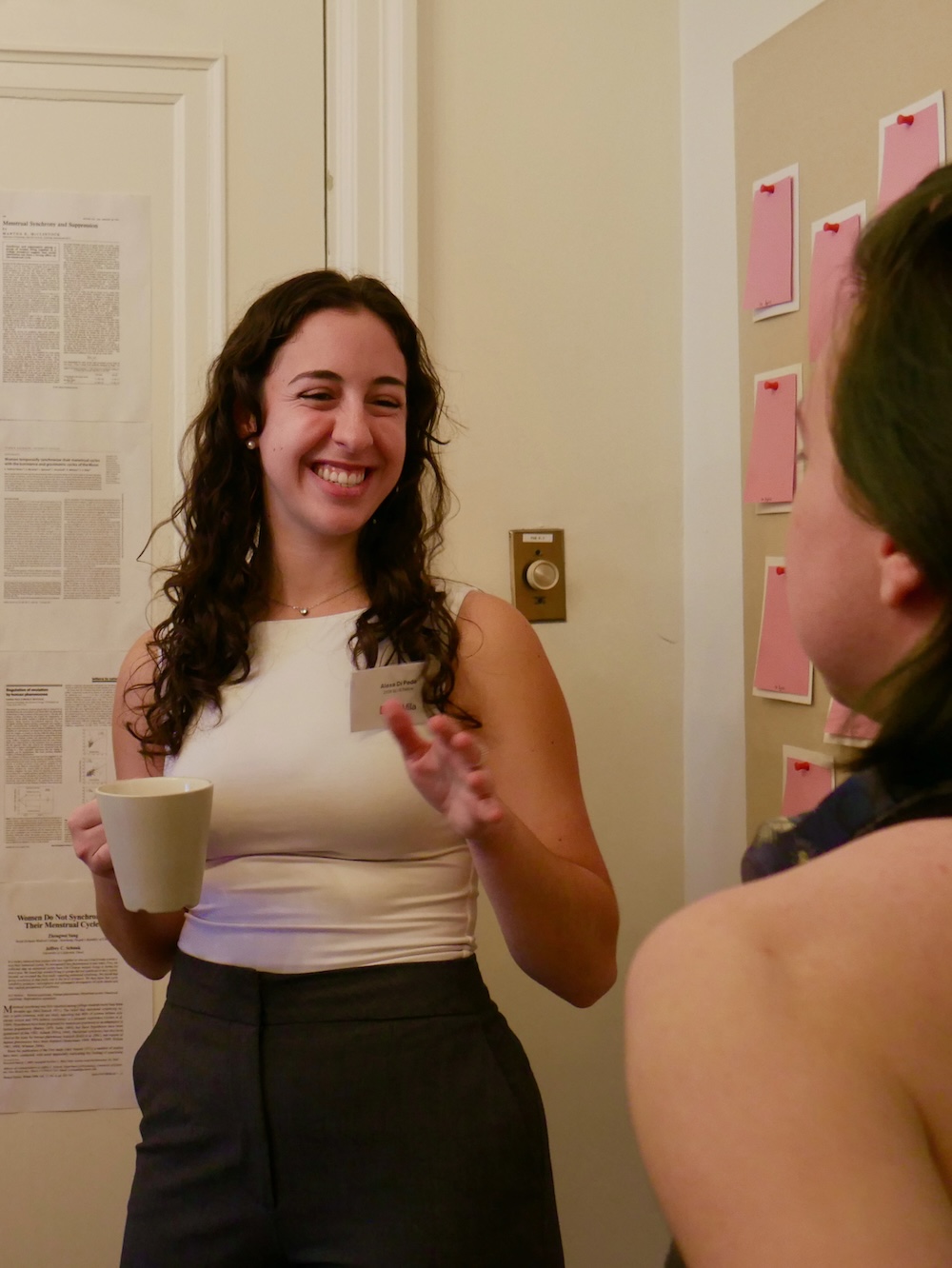
In conversation during the In Sync exhibition. Photo: Alex Nicholas Chen.
In Sync takes all of it, the fifty years, the dispute, the feeling that refuses to go away, and asks two people to sit inside it together. You move through the history of the debate. You map the cycle: its hormonal textures, the way the body opens and closes and turns inward across each phase. You each describe, in one word, how your body feels right now, and watch your answers rendered as waves, separate and almost touching. You place the things you think actually pull people into rhythm. Shared sleep. Shared stress. Shared grief. Shared joy. You watch the field respond, and you ask yourself: what is the rhythm actually made of?
It ends at The Wall. The actual studies, pinned up. Beside them, blank cards and one question: What do you know about your body that science hasn't caught up to yet? People write things down. They read what others wrote. They find the ones that feel like theirs. That is where the research lives: not in the data, but in the moment of recognition. In the feeling that someone finally asked.
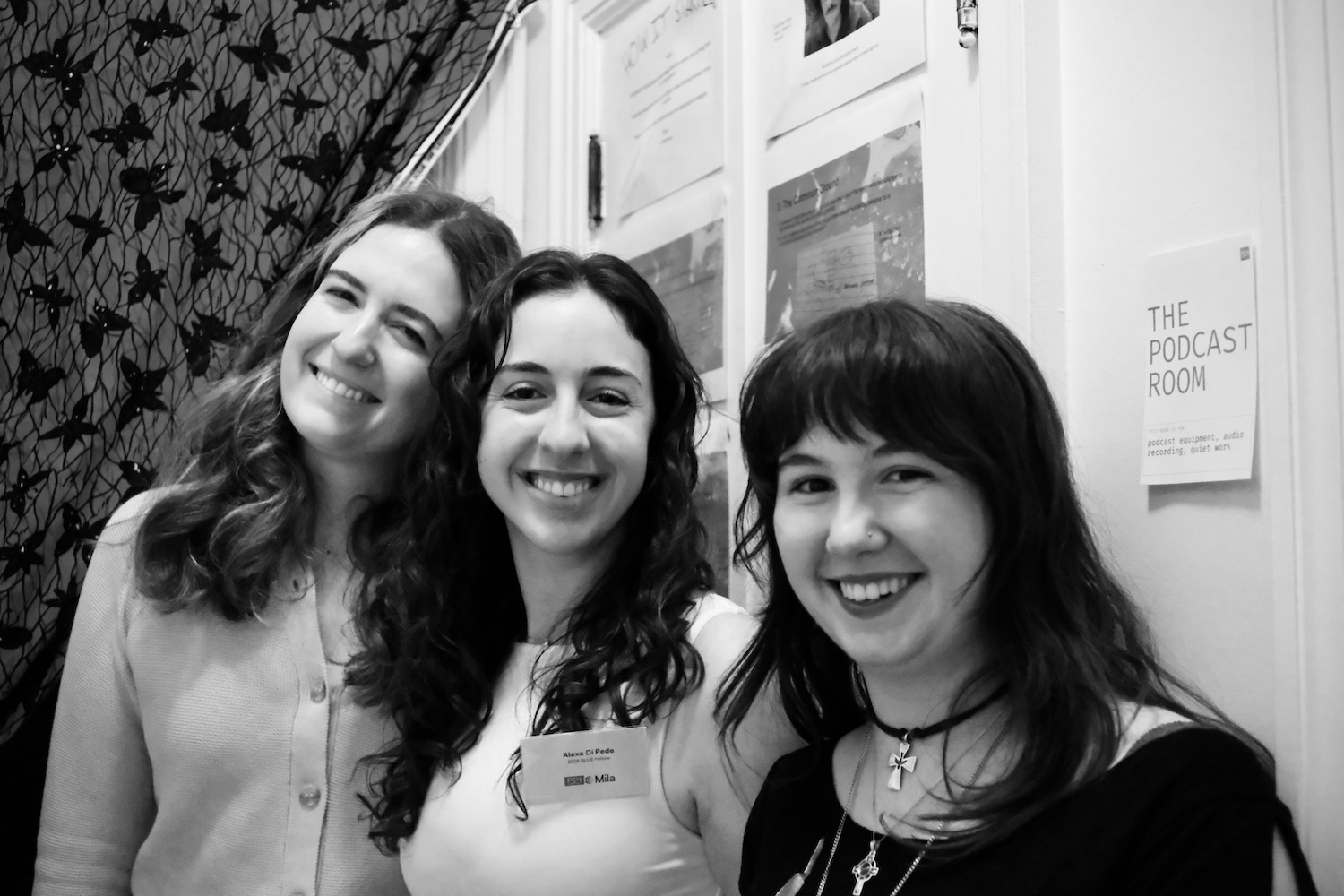
With fellow scholars at the Mila-Building 21 Scholar Exhibition, 2026. Photo: Alex Nicholas Chen.
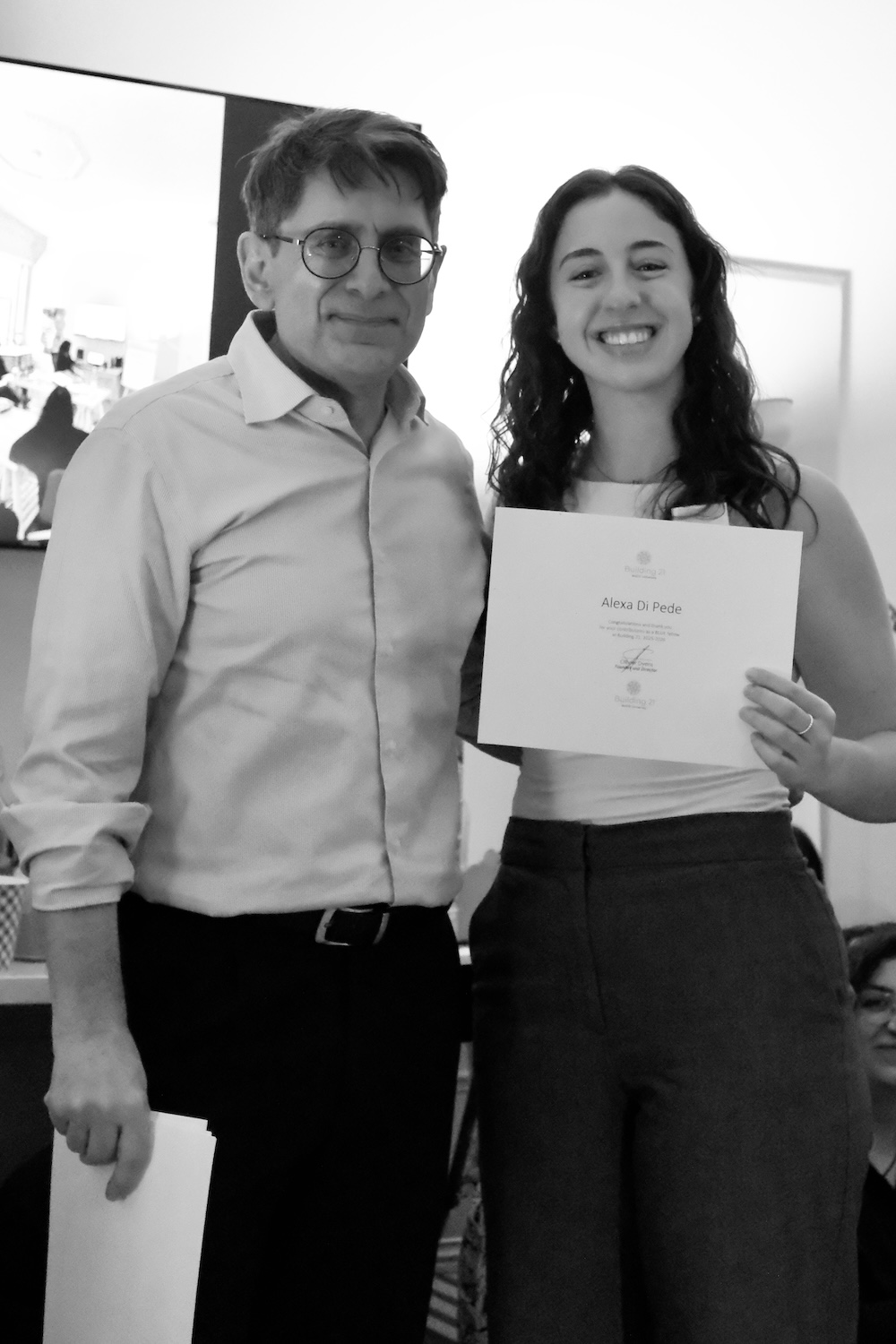
With B21 Founder & Director, Prof. Ollivier Dyens, 2026. Photo: Alex Nicholas Chen.
Hysteria. PMS. Menstrual synchrony. The pattern of dismissing women's embodied knowledge is not a series of mistakes. It is a structure. A way of deciding, before the question is even asked, whose experience qualifies as evidence. What gets lost is not just the data. It is the women who carried the data in their bodies for decades and were told it wasn't there. In Sync is built in their direction, asking what might become visible if we designed instruments around what women already know, rather than around what institutions have already decided.
Whatever future research finds, what I know from building this is: the inquiry itself is the statement. To take a question seriously, to map it, sit with it, build a room for someone to feel it in, is to say that the person asking deserves a rigorous answer. Women's bodies deserve that rigor. The felt experience of moving in rhythm with someone else deserves that care. In Sync is an attempt to offer both.
The frontier of this work is not defined by what the data will show. It is defined by the decision to stop asking women to prove what they already know, and to start building science careful enough to see it.


.svg)