

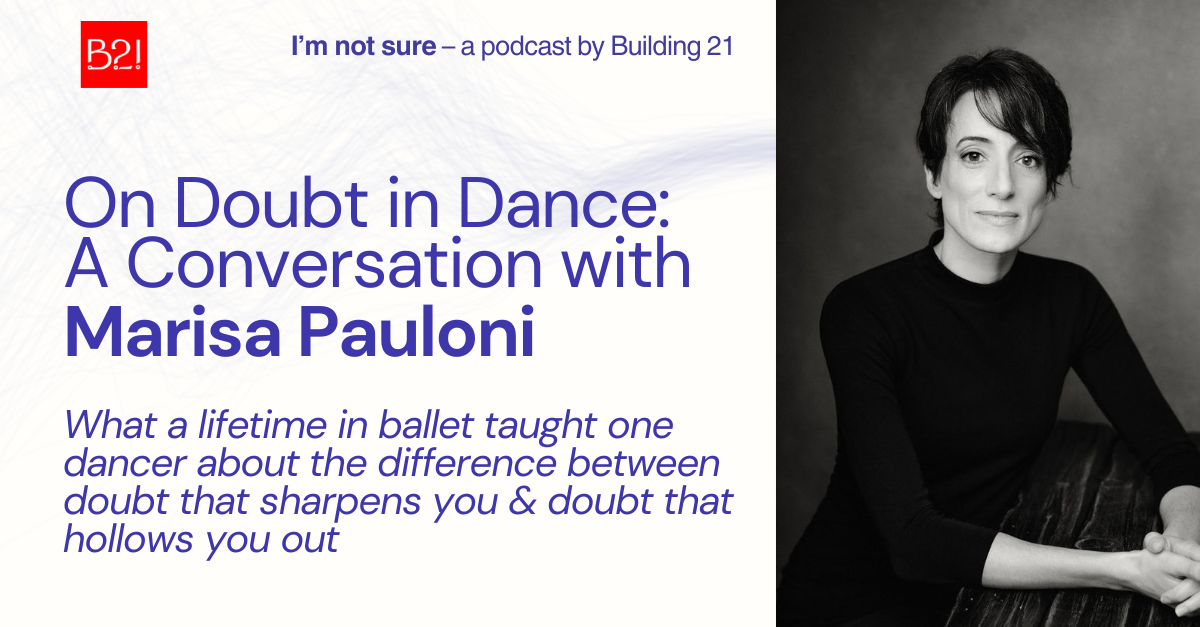
On Doubt
I was born in Montreal, to immigrant parents from Argentina. I started dancing when I was about eight.
Later I was admitted to the École supérieure de ballet du Québec, which was run by Ludmilla Chiriaeff, who had also founded it. That is where I completed all of my training. During those years the school awarded me two merit scholarships, and when I finished I received a substantial grant from the French Consulate General, along with one from the Office franco-québécois, which allowed me to go on training at the École de danse internationale Rosella Hightower, in Cannes.
All through those years of training, one question kept coming back to me, as it did to every one of my classmates: Do I have a chance of making it?
Then, at a certain point, I began to stand out a little more. And the question changed. I remember thinking: All right—maybe I do have a shot at this. Later the doubt shifted again: But will I really make it?
In the end I had a career as a dancer that lasted about fifteen years. I danced in France, in Germany, and for more than ten years with Les Grands Ballets Canadiens. When I left the stage, I was offered the position of ballet mistress with the international company La La La Human Steps. That is where I discovered I loved to teach.
Soon after, with a grant from the Conseil des arts et des lettres du Québec, I spent several months in Argentina studying tango. When I came home, I began teaching that beautiful social dance. In the meantime, I went back to school at HEC Montréal to study arts management, and after that I worked as assistant to the artistic director of Sinha Danse, a contemporary dance company.
At some point I felt drawn to teaching young, aspiring dancers—but if I was going to teach ballet to the young, I wanted to do it with real rigor. So I took specialized training to become a certified ballet teacher. Because to my mind, teaching is not something you improvise. It is a responsibility, and one I take very much to heart.
When my second child was born, I was offered the position of assistant to the artistic director at Les Grands Ballets Canadiens. And since their recreational department opened in 2017, I have been teaching ballet there to adults. I also had the pleasure of teaching for several years in the dance-study program at Ballet Divertimento.
The truth is, from the moment I began my training, I can honestly say I have never left the world of dance.
Today, in front of this microphone, I have been invited to talk to you about doubt in my profession. I am neither a scientist nor a psychologist. What I have to offer rests, above all, on my own experience—as a dancer, as a teacher, as an assistant to an artistic director—but also as the mother of young athletes, and on countless conversations with colleagues over the years.
How would you describe what you are not sure about from your field of expertise?
Doubt has several dimensions, and I will take up a few of them. That said, it is easy to confuse doubt with stage fright. Stage fright is a fleeting reaction—the kind that tends to surface, say, just before you step onstage. Doubt, on the other hand, is a deeper questioning.
In 2007 I had my first child. And in that moment, my capacity to love took on an entirely new dimension. He was a sociable little boy, but very shy, and full of fears. As a parent, I had one wish—simple, but deeply felt: to help him grow braver, and above all, to help him build a healthy sense of his own worth.
But then a question forced itself on me: How do you pass on confidence when you doubt yourself? How do you teach someone to believe in himself when you are still learning to do it yourself? What is doubt? What is confidence? And what does it mean to have a healthy sense of self-worth?
I turned it over for a long time. I wanted to teach with integrity, and I wanted him to grow up sure of himself—and I came to see there was a split between the two.
In our society, I notice a certain unease around doubt. We do not like to feel it, because we so often associate it with weakness, or with insecurity. And yet doubt can be enormously valuable. It forces us to think. It invites us to widen our view, to go a little further. Aristotle put it so well: doubt is the beginning of wisdom. Recently, in a television series, I heard a character say that asking yourself questions leads to open-mindedness and tolerance—and who knows, maybe even acceptance.
But at the pace our society moves now, we tend to want quick answers. And more than anything, we want to appear sure of ourselves—because that reassures other people. And it makes us look good.
In dance, learning usually unfolds in stages: first observation, then understanding, then reproduction, then independence, and finally the ability to pass it on. As a dancer, you had to memorize quickly, you had to reassure whoever was above you—and so, you could not doubt.
So I thank you, very sincerely, for this invitation. Because it lets me share with you today something that may sound uncomfortable, but that is really, to my mind, a luminous story.
What has led you to this "I'm Not Sure"? Why do you think it is something to be "not sure" of?
Whenever we come up against a challenge, I think doubt almost always turns up beside us.
In small doses, doubt is something precious: it wakes up our awareness. It reminds us that there is a risk, a fear, possible consequences. And paradoxically, that is also what makes success so exhilarating. When doubt is entirely absent, the test becomes automatic, and the reward loses a little of its flavor. Take walking: I do it every day without ever doubting I can, and I feel no pride after a few steps. Of course not—it is automatic. But when my children took their first steps—ah, then. I felt an enormous pride. That was a genuine feat.
For a dancer, doubt takes a very particular form. It is often tied to performance, to the result—but it also lodges in the body. Almost like a physical sensation. I would say that in a dancer, doubt inhabits the mind and the body at once, and when it appears, it moves through both. But to the audience, a dancer's doubt must stay invisible.
You have to remember that a dancer's instrument is the body. We tend to speak of the mental and the physical as two separate things, but a dancer is trying to do precisely the opposite—to unite them in an almost perfect symbiosis. One of my teachers used to say, Dancers are God's athletes. I love that line. It captures the union between physical power and inner intensity.
When a dancer performs a role, he is not moving with his muscles alone. He is conveying a state of mind, an emotion, a character. The audience does not only want to watch a physical performance. It wants to feel something.
And so, in dance, we repeat the movements over and over. But the goal is not precision alone. The goal is to transcend the movement—to make the body give off something almost indescribable, something that makes the performance unforgettable. If a dancer is playing someone young or someone old, the movements should not read the same way; the inner state that colors them changes everything. So a dancer works at a role for hours, for weeks, even for months, until the physical body and the thinking body become a single language.
When doubt appears in the body
But for all that work, doubt shows up all the same. Sometimes very often. And when it comes, it can take many forms.
Sometimes the body simply stops answering the way it used to. One day it obeys, the next it resists. Fatigue, an injury, aging, a dulling of sensation—or simply the feeling that you no longer recognize yourself. When the body no longer does exactly what the mind pictures, doubt settles in: I can't feel it. Am I doing this right? Can I still do this?
Sometimes those feelings last only a moment, a single day. Sometimes they linger. Over time—with injuries, with the changes life brings—doubt can take up more and more room. And sometimes a deeper question rises up: Why am I doing this at all?
When doubt grows too invasive, it changes your whole relationship to success. Instead of a joy, success becomes a relief: Phew—I pulled it off. There is a kind of paradox in it: overcoming your doubts can bring pride, but when they grow too heavy, they end up smothering it.
In movement, doubt is visible. It appears as a hesitation. A slight holding-back in the gesture. The body knows what to do, but the mind interrupts. The footing becomes less sure. The weight shifts with caution. The anchoring to the floor turns uncertain—as if the dancer were searching for the ground instead of simply giving in to it. And that hesitation travels up through the whole body. The movement loses its clarity; its bodily voice goes faint.
Where contact with the floor should reassure us, ground us, doubt can produce the strange sensation of weightlessness—even as you are meant to be executing movements on the floor. The body no longer dares to follow its momentum all the way through; it is as if it were wearing a coat several sizes too big. Often the breath shortens. The eyes go looking for validation. And at that point it becomes exhausting—which is a shame.
A particular dimension of a dancer's doubt: the eyes of others
Dance is an intensely exposed art. Everything happens under someone's gaze: the mirror, the teacher, the choreographer, the director, your colleagues, the audience. You cannot fake it for long. Every correction can feed your progress—but it can also crack your confidence.
And sometimes the doubt turns existential. Why dance? For whom? How far? When the passion no longer delivers the sensations that once gave it meaning, when everything hardens into routine, or when the demands crush the pleasure—doubt can become the dominant feeling.
The real danger is not doubt itself. It is when doubt puts out the desire to dance. When it puts out the original flame. When it smothers that inner force—that fire in the belly, that drive, as we say in Quebec—that keeps us going no matter what.
Because doubt makes for a less inhabited dance. Body and mind come apart, as though the dancer had lost his bearings. He is onstage—but he is partly absent from himself. It is a break in the relationship between gesture and intention; it turns the movement into a question rather than a statement. And then the audience does not feel what the dancer is trying to convey. And the dancer knows it.
But—paradoxically—it is also a sign of high standards. Doubt tends to arise in the people who are trying to push the limits, who are after precision, the truth of the gesture, integrity. Tamed well, it can become a fertile tension. Handled badly, it stiffens everything.
My personal experience
That is what I felt at times—like a force that seized me by the throat and lifted me off the ground. I would lose contact with the floor, and with myself.
Whereas in the moments when doubt was faint, I felt held inside a protective bubble. Alone, calm. Wrapped in a reassuring silence. And yet, incredibly, right up close to the audience. As if I were dancing inside a cocoon—free and protected. It was the best feeling there is.
Mental doubt
In the mind, doubt shows up as a constant projection toward failure. What if I miss? The athlete, the dancer, is no longer in the present moment. No longer in the game. He is trying to control—to reassure himself.
You could also say that doubt is a parasite of rhythm. It fragments the flow between movements. You end up dancing, so to speak, in Morse code.
And yet, just as with the physical side, doubt is not only a weakness. It can deepen a dancer's sense of purpose. Give him a second wind, a surge of maturity, a new depth. It often appears after an injury, a memorable failure, or at a moment of transition. It signals that the athlete, the dancer, is taking the measure of what he is risking, and of what he is worth—but worth in whose eyes?
In a more symbolic sense, doubt in an athlete is the moment when strength asks itself: Will it be enough? Not when the body is tired, but when it senses the will begin to waver. And so the dancer becomes the interpreter of his own hesitation.
Unfortunately, in a dancer, doubt is not spoken—it is seen. And worse, it is felt. And as I said earlier, when it comes to other people's eyes, you cannot lie for long.
Doubt in the dance teacher
Today, as a teacher, I see doubt differently. My experience has made me more empathetic. Or so I hope. I understand doubt better now, and I draw on everything I have been through to help my students—to listen to them and to guide them.
In a dance teacher, doubt does not register only in the dancing body. It spreads in other ways—more quietly, but just as legibly.
First it lodges in the demonstration. The movement you show becomes either too emphatic, as if to convince yourself, or too spare, cut short. The teacher wavers between demonstrating "perfectly" and letting the student search, and the movement turns into an open question. But you should know that many teachers can no longer demonstrate at all. So they have to develop the ability to explain instead. Corrections get phrased, rephrased, sometimes contradicted.
Doubt shows up in the teaching posture, too. The teacher's body swings between engagement and withdrawal. It steps in, then stops itself. It lets go. A teacher has to know how to temper her corrections and set them within a hoped-for progression—along a kind of evolving timeline. So she has to project her teaching forward, and project the student's progress along with it.
Doubt also settles into the watching and the listening. The teacher observes longer, looking for signs that the student has understood. That stretched-out moment of observation is doubt leaving its mark on the body. Should I step in, or let it be? And the dancer is wondering: Did she see that or not? Ha.
Finally, doubt writes itself into the voice and the breath, which cannot be separated from the body. The speech turns careful, punctuated by silences, by "maybe," by "try to…" The teacher no longer imposes; she offers. The teaching body becomes less vertical, more horizontal—and you could say that is a good thing. But the dancer is often looking to be guided, reassured, steered toward where to explore. And let us not forget, we are always after quick results.
Doubt has to be managed so it does not blur the student's sense of direction. Otherwise the student loses confidence. Too much doubt weakens the transmission: the student does not understand, does not see. Unlike the dancer, the teacher is less concerned with pleasing. What she is after, above all, is to name the problem and figure out how to help. A teacher's pressure comes from the effectiveness—and the efficiency—of her teaching.
Doubt and consciousness
Doubt and confidence have been the triggers for my search for a better life. Let me explain. For a very long time now, I have been fascinated by the power and the mysteries of the brain. It is an incredibly strong muscle—and by far the most marvelous one.
We have talked about the physical and the mental, and I have lived through stretches where doubt weighed on me more than I would have liked. I believe the greater one's awareness, the more room there is for doubt. But the more solid one's character, the greater one's resilience in the face of it.
We live with doubt. But we get to choose the power and the part we grant it. And above all, we try to keep it on the right side of the Force.
Can or should this "I'm Not Sure" be resolved? In other words, how do we hold on to this "I'm Not Sure" in guiding where we go from here?
Athletes and dancers tend to feel that dance, or sport, is a school for life. It is where you develop perseverance, discipline, the habit of surpassing yourself. Doubt is an integral part of a dancer's path, and it is the ability to move through those doubts that lets a dancer reach full potential.
So no—I do not want to "resolve" doubt. Up to a point, I want to embrace it. It reminds me to take nothing for granted. To be wise, to think, to push past my own limits. Doubt makes me more aware, more alive, less impulsive—even more intelligent. When it turns up, it forces me to question myself and to go and find out more. And so I keep learning, always.
And that—that is exactly what I want. He who doubts little, learns little. That one is from Leonardo da Vinci.

Featuring Marisa Pauloni, Professeure de danse classique, Les Studios Grands Ballet
Co-hosted by: Isabella Chiaravallotti & Anita Parmar
Produced by: Alex Nicholas Chen
Music by: Christian Denis
Graphics by: Sophie Wu
Learn more: building21.ca
.svg)